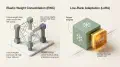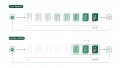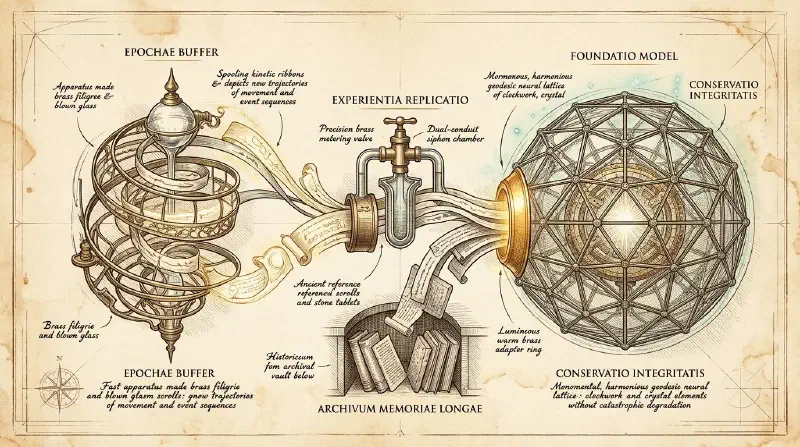
TL;DR: Continually fine-tuning an LLM on narrow domain trajectories shifts conditional token distributions and can overwrite baseline reasoning, instruction following, and general code syntax within a few hundred steps. Drawing on Complementary Learning Systems (CLS) theory, experience replay counters this drift by interleaving new domain examples with a small rehearsal buffer of general pre-training text. Although single-round LoRA fine-tunes often preserve prior capabilities on their own, multi-generation agent loops that create directional gradient interference benefit from mixing roughly 10% pre-cutoff rehearsal data across virtual training epochs.
Why Continual Fine-Tuning Causes Catastrophic Forgetting in LLMs
Standard supervised fine-tuning updates model parameters along the steepest descent direction for the active task objective:
$$\theta_{t+1} = \theta_t-\eta \nabla_\theta \mathcal{L}_{\text{task}}(\theta_t)$$Gradients computed exclusively on narrow task data rarely align with the broad parameter manifold established during pre-training. Repeated steps on specialised agent traces exert strong directional pressure on self-attention projections and feed-forward layers, causing general arithmetic, conversational fluency, and broad programming syntax to degrade. Managing that stability-plasticity trade-off is a central requirement in continual recursive self-improvement pipelines.
Instead of sampling mini-batches solely from the new domain distribution \(\mathcal{D}_{\text{new}}\), experience replay draws from a mixed distribution:
$$\mathcal{D}_{\text{mixed}} = (1-\alpha)\mathcal{D}_{\text{new}} + \alpha \mathcal{D}_{\text{rehearsal}}$$Here \(\alpha \in (0,1)\) sets the rehearsal mixing ratio. Evaluating the loss across both distributions simultaneously produces counter-directional gradients that penalise updates destructive to general capabilities, offering a lightweight alternative to Fisher-matrix penalties such as Elastic Weight Consolidation without storing full-parameter importance tensors.
| Adaptation Strategy | Training Distribution | Parameter Drift Risk | Memory Overhead | Serving Flexibility |
|---|---|---|---|---|
| Vanilla SFT | Current task only (\(\mathcal{D}_{\text{new}}\)) | Severe (rapid erosion of general reasoning) | None | High (single checkpoint) |
| Parameter Freezing | Base frozen, task heads updated | Low (base preserved, capacity restricted) | Moderate | Moderate (multiple heads) |
| Elastic Weight Consolidation | Current task plus Fisher penalty | Moderate (diagonal Fisher degrades across tasks) | High (\(O(N)\) Fisher storage) | High (single checkpoint) |
| LoRA Rehearsal Replay | \(\mathcal{D}_{\text{new}} + \mathcal{D}_{\text{rehearsal}}\) | Minimal (regularised gradient trajectory) | Low (compact text buffer + low-rank weights) | High (swappable adapters) |
Complementary Learning Systems and Replay in Transformers
Machine learning researchers often explain why experience replay stabilises continual updates through cognitive neuroscience. The foundational Complementary Learning Systems paper by McClelland, McNaughton, and O’Reilly (1995) showed why biological brains cannot write every new episode directly into dense cortical weights without overwriting older memories.
Fast Episodic Memory Versus Slow Neocortical Consolidation
Biological cognition separates learning into two interacting subsystems, later connected directly to artificial replay buffers in an updated CLS systems review by Kumaran, Hassabis, and McClelland:
- The Hippocampus (Fast Episodic Learner): Rapidly binds distinct sensory events into episodic traces without immediately altering global semantic representations.
- The Neocortex (Slow Structured Consolidator): Extracts statistical regularities and durable world knowledge across prolonged timescales using small, conservative weight updates.
- Offline System Consolidation: During rest, hippocampal traces replay alongside older representations so the neocortex integrates new skills without collapsing existing attractors.
Biological CLS Architecture:
[ Environment ] ---> ( Hippocampus: Fast Episodic Store )
                             |
                             v Interleaved Replay (Consolidation)
                     ( Neocortex: Slow Structured Memory )

Modern LLM Continual Learning Mapping:
[ Agent Environment ] ---> ( Context Window & Episode Logs )
                                   |
                                   v Multi-Epoch Rehearsal Buffer SFT
                           ( Frozen Base Weights + Fresh LoRA Adapter )
Mapping Episodic and Parametric Channels to LLM Agents
In self-training LLM harnesses, including the container loop in our Negative Space Learning paper, those biological roles map onto three concrete components:
- Episodic Scratchpad: The active context window, tool logs, and multi-turn shell outputs gathered within a single episode.
- Parametric Base Model: The frozen pre-trained checkpoint (\(W_0\)) holding broad language priors and general reasoning structures.
- Consolidation Channel: A fresh low-rank adapter (\(\Delta W = BA\)) trained periodically on verified task episodes interleaved with rehearsal rows.
Designing a Rehearsal Buffer for LoRA Fine-Tuning
Before building a rehearsal pipeline, check whether your workload actually needs one. As shown in the LoRA forgets less study, low-rank updates restrict plasticity enough that many single-round domain fine-tunes preserve baseline benchmarks without extra replay data; rehearsal matters primarily when narrow self-generated formats or multi-round loops induce strong gradient interference.
Comparing Task-History, Prioritised, and Pre-Cutoff Buffers
When rehearsal is needed, practitioners choose among three sampling pools:
- Uniform Task History Replay: Sampling passing trajectories from all earlier tasks or generations uniformly, which grows linearly over time and can retain obsolete strategies when environments shift.
- Prioritised Loss-Based Replay: Oversampling high-surprisal historical rows, which helps in compact reinforcement learning tasks but often amplifies noisy or malformed completions in language models.
- Pre-Cutoff General Corpus Replay: Mixing a small static slice from clean corpora published before the base model’s knowledge cutoff (such as Stack Exchange Paired or filtered Wikipedia continuations).
Recent experiments in the General Sample Replay paper confirm that a small fixed pool of general pre-training samples protects instruction following and reasoning across long sequences of downstream LLM updates. Because pre-cutoff tokens already sit on the base model’s pre-training manifold, they anchor attention calibration without introducing task contamination.
Gradient Interference and How Rehearsal Bounds Drift
Consider trainable low-rank parameters \(\theta\) attached to frozen base weights \(\theta_0\) via \(\theta_0 + (\alpha_r / r)BA\). Across a mixed batch with rehearsal ratio \(\alpha\), expected loss decomposes into:
$$\mathcal{L}_{\text{total}}(\theta) = (1-\alpha)\mathbb{E}_{(x,y)\sim\mathcal{D}_{\text{domain}}}[\ell(f_\theta(x),y)] + \alpha\mathbb{E}_{(x',y')\sim\mathcal{D}_{\text{rehearsal}}}[\ell(f_\theta(x'),y')]$$Directional Alignment Against Negative Inner Products
As formalised in the CLEAR experience replay paper, forgetting accelerates whenever the inner product between the domain gradient \(g_{\text{domain}}\) and prior-knowledge gradient \(g_{\text{prior}}\) turns negative (\(\langle g_{\text{domain}}, g_{\text{prior}}\rangle < 0\)), since stepping along \(-g_{\text{domain}}\) raises prior loss:
$$\mathcal{L}_{\text{prior}}(\theta-\eta g_{\text{domain}}) \approx \mathcal{L}_{\text{prior}}(\theta)-\eta\langle g_{\text{prior}}, g_{\text{domain}}\rangle > \mathcal{L}_{\text{prior}}(\theta)$$Evaluating \(g_{\text{step}} = (1-\alpha)g_{\text{domain}} + \alpha g_{\text{rehearsal}}\) inside the same optimisation step shifts the projection onto the rehearsal manifold to \((1-\alpha)\langle g_{\text{domain}}, g_{\text{rehearsal}}\rangle + \alpha\|g_{\text{rehearsal}}\|^2\). Whenever \(\alpha\|g_{\text{rehearsal}}\|^2\) offsets negative cross-terms, updates stay aligned with general language competence.
Implementing a Multi-Epoch Rehearsal Buffer in PyTorch
In our continual QLoRA training pipeline, each virtual epoch draws a distinct seeded slice of pre-cutoff passages, masks prompt tokens with -100 so loss applies only to completions, and shuffles those rows with verified domain trajectories:
import random
from datasets import Dataset, load_dataset

def build_rehearsal_mixed_dataset(
    domain_rows: list[dict], tokenizer, dataset_name: str,
    rows_per_epoch: int = 500, virtual_epochs: int = 3, seed: int = 42,
) -> Dataset:
    corpus = [
        " ".join(r["text"].split())[:2048]
        for r in load_dataset(dataset_name, split="train")
        if isinstance(r.get("text"), str) and r["text"].strip()
    ]
    combined: list[dict] = []
    for epoch in range(virtual_epochs):
        combined.extend(domain_rows)
        for passage in random.Random(seed + epoch).sample(corpus, min(rows_per_epoch, len(corpus))):
            prefix = f"<|im_start|>user\nContinue the following passage:\n\n{passage[:256]}<|im_end|>\n<|im_start|>assistant\n"
            tok = tokenizer(f"{prefix}{passage}<|im_end|>", max_length=2048, truncation=True)
            plen = len(tokenizer(prefix)["input_ids"])
            tok["labels"] = [-100 if i < plen else t for i, t in enumerate(tok["input_ids"])]
            combined.append(tok)
    random.shuffle(combined)
    return Dataset.from_list(combined)
Attaching Low-Rank Adapters and Benchmarking Replay Schedules
Once the mixed dataset is built, the Hugging Face PEFT library attaches fresh rank-32 LoRA adapters (q_proj, k_proj, v_proj, o_proj) to the frozen 4-bit base model without modifying base weights on disk.
Teams evaluating replay ratios across multi-stage task streams can track backward transfer and forgetting metrics with the Avalanche continual learning library.
For multi-generation agent experiments using 4,500 verified container rows plus 500 Stack Exchange rehearsal rows per generation (10% rehearsal share), inspect the full harness in the Negative Space Learning repository.
FAQs
Does LoRA fine-tuning always require an experience replay buffer?
No, single-round LoRA fine-tuning often preserves general capabilities on its own because low-rank adapters restrict parameter drift relative to full fine-tuning. A rehearsal buffer becomes valuable when multi-round self-training or rigid output formats create directional gradient interference that degrades general reasoning, coding syntax, or instruction following.
What is the best rehearsal mixing ratio for LLM fine-tuning?
A rehearsal share around 10% (\(\alpha = 0.10\), such as 500 general rehearsal rows alongside 4,500 domain rows per generation) works reliably in practice. That ratio supplies enough regularising gradient signal to anchor general language fluency while dedicating 90% of optimisation steps to the target domain.
What data should go into an LLM rehearsal buffer?
Clean, static pre-cutoff general text (such as Stack Exchange Paired or filtered Wikipedia passages published before the base model’s training cutoff) is safer than raw historical agent logs. Pre-cutoff text already matches the base model’s pre-training distribution, avoiding stale strategies or synthetic artifacts.
Does experience replay increase GPU VRAM usage during LoRA training?
No, peak GPU VRAM stays effectively unchanged during training. Rehearsal rows are tokenised to the same max_seq_length and interleaved into standard mini-batches rather than processed by a second reference network in memory, adding only roughly 10% more gradient steps per epoch.
How does a rehearsal buffer differ from a sliding window of recent runs?
A sliding window bounds which domain generations remain active so obsolete task strategies age out when an environment changes, whereas a static pre-cutoff rehearsal buffer anchors general language and reasoning priors. Pairing both lets an agent drop stale task habits without eroding baseline fluency.