TL;DR
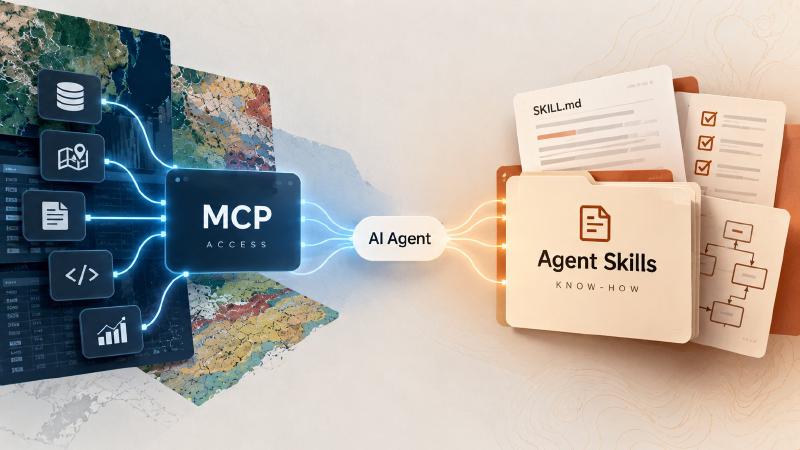
- Agent Skills and MCP both make an AI agent (an AI that does tasks on a computer, not only chats) more useful. MCP connects it to other software and data; a Skill is a written how-to guide for one kind of task.
- Think of a new employee. MCP gives them logins to the company’s systems; a Skill is the manual for a job they do often.
- If the AI can’t reach something, you need MCP. If it can reach everything but does the job differently each time, you need a Skill. Most setups use both.
Key Takeaways
- MCP gives access; a Skill gives know-how. Our map program gave AI agents 10 new tools, yet they still made up names for the rock types in a map’s colour key.
- A Skill is much easier to make. It is a text file, like a manual; an MCP connection is a program someone has to build, run and maintain.
- A Skill waits in the background until it is needed. The AI sees only a 22-word summary of our benchmark-writing Skill until a task needs it, but connected tools are often described with every message.
- They are built to work together. Anthropic, the company behind Claude, even publishes a Skill that teaches an AI to build an MCP connection.
Agent Skills vs MCP is a question most people meet when setting up an AI agent, especially in Claude, where both sit side by side.
We use both at Eigenform. Our agents reach geology data and scanned maps through two MCP servers we built. The questions in Groundtruth, Eigenform’s open source dynamic benchmark, are drafted with a Skill we publish.
What is MCP?
MCP (Model Context Protocol) is an open standard for connecting AI applications to external systems: data sources, tools and workflows. An MCP server exposes these as tools the model can call, resources it can read and prompt templates, and any MCP-compatible app can connect to it.
The app that runs the AI, such as Claude or ChatGPT, is the MCP host, and it opens one client connection per server. Because the integration lives in the server, it is written once and works in every compatible app.
Stratigraphic Amenity, our open-source toolkit for scanned geological maps, runs as a local MCP server with 10 tools. They range from registering and georeferencing a map to querying fault and mineral data for its area.
Geocluster MCP, our server for tabular and spatial geoscience data, is the tool layer behind our research harness. Both are among our MCP servers for geology data and maps. They give an agent a fixed, checkable set of operations instead of throwaway scripts against raw files. That is access, not yet competence.
What are Agent Skills?
Agent Skills are folders of instructions, and optionally scripts and reference files, that teach an AI agent how to do a specific task. Each Skill has a SKILL.md file whose short header gives a name and a description. The agent reads the full instructions only when a task matches that description.
Anthropic developed the format and released it as an open standard, now supported by Claude, ChatGPT and Codex, Gemini CLI, GitHub Copilot, Cursor and others. In Claude they are often called Claude Skills, so Claude Skills vs MCP is the same comparison under another name.
How an agent loads a Skill
Skills load in three stages. At startup the agent sees only each Skill’s name and description, about 100 tokens per Skill according to Anthropic’s documentation. When a request matches, it reads the SKILL.md body, guided to stay under 5,000 tokens. Bundled files load only when the instructions point to them, and bundled scripts run without their code entering the conversation, only their output.
Groundtruth ships a Skill for writing its benchmark questions. Its header is 22 words; the whole file is 5,038 words across 17 sections, well above the 5,000-token guideline. We accept it because the agent pays for those words only when it writes benchmark questions.
A Skill can teach MCP work
Skills can also teach an agent how to work with MCP. The MCP builder skill that Anthropic publishes guides an agent through building an MCP server in Python with FastMCP or in TypeScript. Its advice covers consistent tool-name prefixes, short tool descriptions and error messages that tell the agent what to do next.
Geocluster MCP is built on FastMCP and shares one of those habits: tool names grouped by prefix, such as voxel_ and classify_text_.
Agent Skills vs. MCP: main differences
Side by side, Agent Skills vs MCP is a split between reach and competence.
| Dimension | MCP | Agent Skills |
|---|---|---|
| What it provides | Access to external tools, data and services | Reusable instructions and procedures for a specific task |
| Solves | Reach: what the agent can connect to | Competence: how well the agent does a task |
| Typical setup effort | A server to build, run and maintain | Written instructions, closer to documentation |
| Where it lives | An external integration layer, local or remote | A folder the agent reads into its context when needed |
| Cost while unused | Tool definitions, often sent with every request | A name and a one-line description |
| Fails when | The tool or data source is unreachable or misconfigured | The instructions are vague, outdated or don’t match the task |
Tool definitions and Skill instructions compete for the same space, the AI agent context window, which the model reads on every request. Stratigraphic Amenity’s 10 tool definitions come to 16,468 characters of JSON. A host that loads every tool up front pays that on every turn.
When we gave real agents real maps, the access worked and the use did not. Agents invented legend labels and read a result holding 86 mineral occurrences as “1 item”. The fix was an MCP tool design change, not a Skill: the server’s result text now states record counts and missing fields in words. A competence problem caused by a misleading tool is a tool problem.
Agent Skills vs. tools
A tool is a single action an agent can call, such as reading a file or georeferencing a map. An MCP tool is one kind, and a built-in shell is another. A Skill adds no tools. It tells the agent which tools to use, in what order and what a good result looks like.
So a Skill cannot grant access. In our research harness, each specialist agent may only call the Geocluster MCP tools whose names match its allowed patterns. Tests pin those patterns, so a rename cannot widen access. A Skill can tell an agent to build a voxel model, but cannot hand it a voxel tool it was not given.
When to use Agent Skills vs MCP
Four questions settle most Agent Skills vs MCP decisions:
- Can the agent reach the system or data at all? If not, you need MCP (or another integration).
- Can it reach everything, but produce uneven results on a task it repeats? Write a Skill.
- Must a rule hold even if the model ignores its instructions? Put it in code, on the server side.
- Does the procedure depend on connected tools? Use both.
Use MCP when the agent needs a new system
MCP is the answer when the gap is reach: a database, an internal service, live data or an action with side effects. It is also where enforcement belongs. In Stratigraphic Amenity, the tools that install assets take no arguments at all, so a model cannot talk them into fetching anything outside the approved list. No instruction file could promise that.
Use an Agent Skill when the agent can already do the task
A Skill is the answer when the agent has every tool it needs and still does the job differently each time. Writing benchmark questions is our example. Any capable agent can read reports and write questions. Our Skill makes it explore the source documents first, then plan and draft the questions. Answers and grading rules come in a separate pass, and the set is not finished until every validation gate passes.
That is the “AI skills vs MCP” split in one line: the agent already had the access, and what it lacked was the procedure.
Use both when the procedure depends on connected tools
A map server gives an agent the operations, but the right order of calls and the traps between them are procedure. Previews of a scanned map, for example, are a different coordinate frame from the full image, so an agent must never measure coordinates from one. A Skill is the natural place for rules like that. Our Geocluster Research Harness pairs its MCP tools with a geology agent’s standing instructions in the same way.
Both specifications are recent and still changing, so check your host’s current documentation.
FAQs
What is the difference between Agent Skills and MCP?
The core of Agent Skills vs MCP is access versus know-how. MCP connects an AI agent to external systems through a standard server, so it can call tools and read data it could not reach before. An Agent Skill is a folder of instructions, and optionally scripts, that teaches the agent to do a specific task well.
What does an MCP server do?
An MCP server exposes an external system to AI applications in a standard form. It offers tools the model can call, resources it can read and prompt templates. Any MCP-compatible host, such as Claude, ChatGPT or an IDE, can connect to it without a custom connector. Local servers talk over standard input and output; remote ones over HTTP.
What are Agent Skills in Claude?
In Claude, Agent Skills (often called Claude Skills) are folders with a SKILL.md file that Claude loads when a request matches their description. Claude Code reads them from a skills folder in your home directory or project. In claude.ai and the Claude API, they run in a code execution environment.
Do Agent Skills replace MCP?
No. A Skill cannot give an agent access to a system it is not connected to, because it adds instructions, not tools. If the data or service is outside the agent’s reach, you still need MCP or another integration. Skills replace repeated prompting: the same guidance, written once and loaded automatically when a task needs it.
Can you use Agent Skills and MCP together?
Yes, and most real setups do. MCP provides the connection to a system, and a Skill describes how to use those tools well: which to call, in what order and which traps to avoid. Anthropic’s own MCP builder skill goes the other way, teaching an agent how to build a new MCP server from scratch.