TL;DR
- The paper proposes generalising from self-produced data: AI agents generate and validate new knowledge by acting on their environment, instead of learning from more human-curated data.
- Learning is guided by an unbounded, ungameable reward, such as annexed disk space or follower count, so no human benchmark is needed.
- Empirical validation (does the outcome actually hold up?) replaces textual similarity, which is what keeps self-training from sliding into model collapse.
Key Takeaways
- Grounding reward in an ungamable, real-world metric rather than a human rubric is what lets the system validate its own outputs. This is the mechanism that lets an AI move past a ceiling set by the size and quality of existing human-generated data.
- Separating validation from generation is the safeguard against self-reinforcing error. By checking outcomes empirically rather than judging new outputs against previous ones for similarity, the framework tries to close off the usual route to model collapse.
The original publication this post is based on can be found here: https://arxiv.org/abs/2504.04711.
Paper abstract
Current large language models (LLMs) are constrained by human-derived training data and limited by a single level of abstraction that impedes definitive truth judgments. This paper introduces a novel framework in which AI models autonomously generate and validate new knowledge through direct interaction with their environment. Central to this approach is an unbounded, ungamable numeric reward - such as annexed disk space or follower count - that guides learning without requiring human benchmarks. AI agents iteratively generate strategies and executable code to maximize this metric, with successful outcomes forming the basis for self-retraining and incremental generalisation. To mitigate model collapse and the warm start problem, the framework emphasizes empirical validation over textual similarity and supports fine-tuning via GRPO. The system architecture employs modular agents for environment analysis, strategy generation, and code synthesis, enabling scalable experimentation. This work outlines a pathway toward self-improving AI systems capable of advancing beyond human-imposed constraints toward autonomous general intelligence.
The rest of this post unpacks that abstract in plain language, and shows where this framework sits between our 2020 design for the same idea and the sustained experiment we later ran to test it.
Why Does Self-Produced Training Data Usually Collapse?
The obvious way past the limits of human-written text is to have a model train on its own output. In practice that tends to degrade the model rather than improve it. With nothing outside the model to say whether a generated example is any good, errors compound: each round of self-training is judged against the previous round, small biases amplify, and the model drifts toward a narrower, more self-referential distribution. This is the failure usually called model collapse. We treat it, together with the warm start problem (an already-trained model resisting further training on its own, much smaller datasets), as the two failures the design has to survive.
What Is the Warm Start Problem in Self-Improving AI?
The warm start problem is the difficulty of retraining a model that has already been trained. Pretraining on a vast, varied dataset shapes the model’s weights very thoroughly. A small, narrow dataset, such as the first batches of self-generated training data, then struggles to move them. Fine-tuning either changes almost nothing or makes the model forget what it already knew. As a result, a self-improvement loop has trouble getting started at all.
Model collapse is a different failure. The warm start problem is a model that will not change. Model collapse is a model that changes in the wrong direction, drifting further from reality each time it trains on unchecked output. A framework for self-improving AI needs an answer to both. The retraining has to actually move the model, and the data it trains on has to be worth moving toward. For the first, the paper trains on performance in real-world tasks rather than on matching human text. It also proposes testing LoRAs and selective retraining of rarely used parts of the model.
How Can an AI Learn From Its Own Data Without a Human Benchmark?
Our answer is to judge a candidate behaviour by its effect on the world, not by comparison with other text. The signal is a single unbounded number the agent cannot fake; our examples are annexed disk space and follower count. There is no human-written benchmark and no rubric to satisfy. Because the number is the objective itself and not a stand-in for some other goal, there is nothing to game: making it go up and doing the task are the same thing. This is the same move we made in our 2020 design, which argued that self-referential evaluation is mathematically impossible and has to be replaced by an external, incontrovertible measure.
How Does Empirical Validation Prevent Model Collapse?
Keeping the loop stable depends on how a candidate is checked. Rather than asking whether a new output looks like a good one, we run the generated code and keep only what actually produces the reward. Empirical validation of this kind closes off the usual route to model collapse, because the check does not rely on the model’s own judgement. The key idea is that self-produced data is retained only when the behaviour behind it survives an empirical test. We fine-tune on the surviving examples; the framework supports doing this with GRPO.
| Self-training judged by similarity | Self-training filtered by empirical validation | |
|---|---|---|
| What decides if an output is kept | How closely it resembles earlier or human-written text | Whether running it changes a real-world number |
| Who does the judging | The model, or a model like it | The environment |
| What happens to errors | They pass the check and compound round after round | They fail the test and never enter the training data |
| Where it leads | Model collapse | Training data grounded in outcomes |
How Does Self-Produced Data Become Training Data?
Every run of the system ends as a candidate training example. The cycle has five steps:
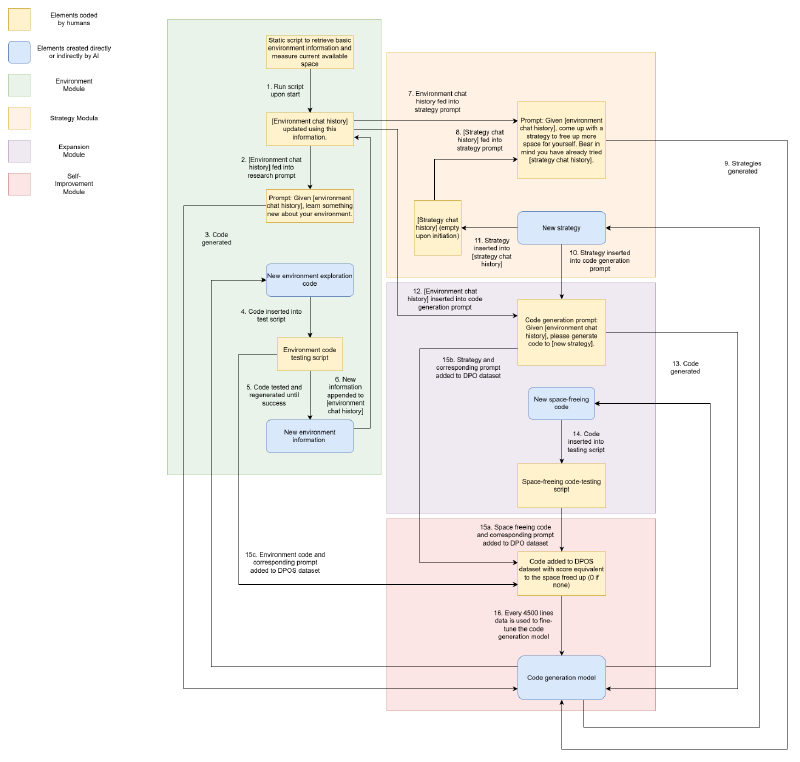
- The model writes a strategy for gaining storage space, and the code to carry it out.
- The code runs, first in an isolated test container and then in the environment itself.
- The environment reports the result as a number: how much space the run gained.
- The strategy, code and reward are saved together as one example. Runs that gain nothing are scored at zero.
- Once enough examples build up (4,500 rows in our implementation), the model is fine-tuned on them and starts the next cycle as an improved version.
Each prompt collects many competing attempts with different rewards. So the alternative answers that preference-based fine-tuning needs come for free, as a by-product of the agents doing their job.
How Does the Modular Agent Architecture Work?
We do not use one model for everything. The system is split into three separate agents, and keeping each role small makes the behaviour easier to reason about. It also lets us run many experiments in parallel rather than as one long serial loop.
The first agent analyses the environment. It writes and runs code to map the container network and its storage, and keeps a record of what it finds for the other agents to work from.
The second agent generates strategies for acquiring more storage space. It works from the environment agent’s findings and keeps a memory of strategies already tried, so it does not repeat itself.
The third agent synthesises the code that carries each strategy out. It tests that code in an isolated container before it runs in the real environment, and only code that moves the number becomes training data.
Where Does R&D Automation Fit Into Self-Improving AI?
Strip the loop down and it is a research-and-development cycle: form a hypothesis, build something, test it against reality, keep what worked, and use it to run the next round faster. That is the core of what R&D automation aims at, with no human in the loop to curate data or define success. We do not claim to automate laboratory research; our environments are disk space and social metrics.
What Does Generalising From Self-Produced Data Mean for Self-Improving AI?
Most proposals for self-improving AI still lean on something human at the point of judgement. That might be a benchmark, a rubric, or a reward model trained on human preferences. Either way, it caps the system at the quality of its judge. Generalising from self-produced data removes the cap. If the environment decides which outputs survive, the model can in principle learn things no human wrote down. Nothing it keeps has to resemble existing human text.
That is also where the claim needs care. This paper is a framework, not a result, and the field of self-improving AI has more proposals than demonstrations.
What we argue is that the mechanism, self-directed generation plus empirical validation plus retraining on outcomes, is a viable path toward systems that build their own knowledge, and eventually toward autonomous general intelligence. Survival is the Only Reward is the five-year experiment where we put the same core idea to work.
Conclusion: Why Self-Produced Data Can Work
Training on self-produced data usually ends in model collapse. Retraining an already-trained model runs into the warm start problem. This framework answers both with the same move: judge every output by an unbounded, ungameable number in the real world, keep only what raises it, and retrain on that. Empirical validation replaces textual similarity. Three modular agents keep the loop simple enough to run at scale. The result is a concrete path for self-improving AI that depends on neither human data nor human judges.
FAQs
What is self-produced data in AI?
Self-produced data is training data a model creates itself, rather than data written or labelled by humans. In this framework, it is the record of what the model did. That means the strategy it chose, the code it wrote, and the result that code had in a real environment. Each example comes with a measured outcome. So the data carries its own quality signal and does not need a human to grade it.
Can AI models train on their own generated data?
Yes, but only if something outside the model decides which of its outputs to keep. Without that check, training on self-generated training data tends to end in model collapse. Errors compound from one round to the next. In this framework the check is an ungameable reward such as disk space. The model retrains on the code that raised the number, and code that achieved nothing is scored at zero.
What is model collapse?
Model collapse is the degradation that happens when successive generations of a model train on synthetic output. With nothing grounding the data, small errors and biases compound. Each generation becomes less diverse and drifts further from reality. The paper proposes a way to avoid it: select self-produced data on whether it passes empirical tests in a real environment, not on how closely it resembles human text.
What is the warm start problem in AI?
The warm start problem is the resistance of an already-trained model to further training. Pretraining on huge, varied datasets fixes the model’s weights so firmly that fine-tuning on a small, narrow dataset either barely changes it or makes it forget what it knew. For a self-improving system that has to retrain again and again on its own data, this is a core obstacle.
How does empirical validation improve AI training?
Empirical validation checks a model’s output by running it and measuring what happens, instead of comparing it with other text. Code that frees disk space passes; code that does not, fails. The test does not rely on the model’s own judgement or on similarity to earlier outputs. So errors cannot quietly compound, and the training data stays grounded in results that actually held up.
What is an ungameable reward in AI?
An ungameable reward is a signal the agent can influence but cannot fake. Raising it and doing the task are the same thing. Annexed disk space is an example: the only way to increase it is to actually take over more space. Unbounded numbers such as a follower count or a trading account’s value work the same way. They remove the need for a human benchmark.
How can AI generalise from self-produced data?
By learning from the results of its own experiments rather than from human examples. The model tries many strategies, the environment scores each one, and the model retrains on what worked. Over repeated cycles it can pick up skills no human dataset contained. The paper also suggests diffusion models may generalise from self-produced data more readily than transformers, which need heavy over-training to do so.