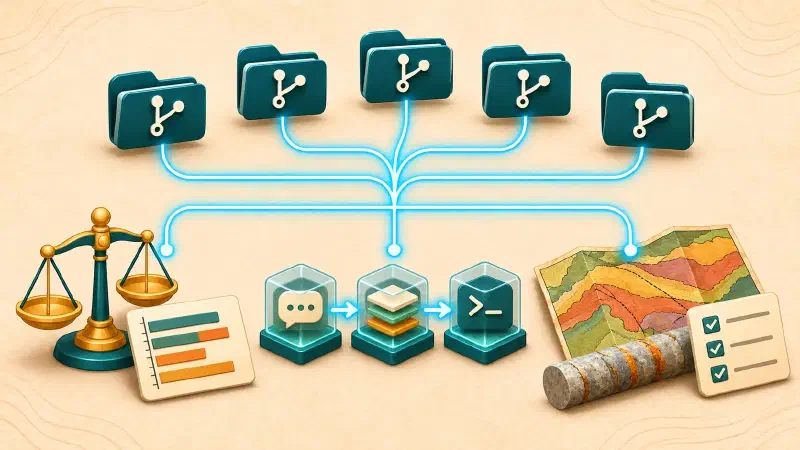
TL;DR LLM evaluation GitHub repos are free, open-source programs that test how accurate and reliable a large language model (LLM) is before teams trust its answers. General-purpose evaluation frameworks test broad capabilities: running base models on standard exams, testing full AI apps, checking whether a document-search assistant pulls the right sources (often called RAG), or comparing prompt versions and security risks. Domain benchmarks test specialist work instead: Eigenform’s Groundtruth Dynamic Benchmarking checks whether an AI can reason accurately over real geological records and back up its answers with evidence. The right repository depends on whether you are testing a model, an application, a retrieval pipeline, an AI agent or a specialist workflow.
LLM evaluation is not a single test. Different LLM evaluation GitHub repos measure different layers of an AI system, from base model scores to retrieval quality and prompt regressions. This guide compares four widely used open-source evaluation frameworks and explains where a domain-specific benchmark such as Groundtruth Dynamic Benchmarking fits alongside them.
Best General-Purpose LLM Evaluation GitHub Repos
General-purpose evaluation frameworks give teams repeatable ways to test models and applications across common engineering tasks. Each repository below focuses on a distinct layer of the stack: academic benchmarks, end-to-end applications, RAG pipelines, or prompt and security testing.
1. lm-evaluation-harness: Standardised Model Benchmark Runs
lm-evaluation-harness on GitHub
Developed by EleutherAI, lm-evaluation-harness provides a unified framework for running language models against standardised academic and research benchmarks.
It is built for comparing base and fine-tuned models across established tasks. Researchers can also configure custom tasks and evaluation metrics.
Key capabilities include:
- More than 60 standard academic benchmarks, with hundreds of subtasks and variants.
- Support for Hugging Face Transformers.
- Integration with vLLM and other supported backends.
- Evaluation of local and API-based models.
- Custom task configurations, prompts and metrics.
The framework is suited to reproducible experiments under consistent evaluation conditions. It is not primarily designed for testing every part of a production application, so teams evaluating retrieval, agent behaviour or application workflows usually pair it with other tools.
For more context on how model tests and benchmark results differ, see Eigenform’s guide to AI model evaluation methods and benchmarks.
Best for: Researchers and developers running standardised, reproducible model benchmarks.
2. DeepEval: Testing LLM Applications and Agents
DeepEval evaluates complete LLM applications, not just base models. Its approach resembles software unit testing: developers define evaluation criteria and run automated checks against model outputs.
Key capabilities include:
- End-to-end LLM application testing.
- Evaluation of agent steps and complete agent trajectories.
- RAG pipeline evaluation.
- Answer relevancy and faithfulness metrics.
- Hallucination detection.
- Custom evaluation metrics.
- CI/CD integration.
DeepEval includes metrics such as G-Eval, answer relevancy, contextual recall and faithfulness. For example, a team building a customer-support chatbot can test whether responses remain relevant and grounded after a prompt or model change, then run those checks in CI/CD to catch regressions before deployment.
Best for: Developers testing LLM applications, chatbots, RAG systems and AI agents.
3. Ragas: Evaluating RAG Pipelines
Ragas focuses on retrieval-augmented generation (RAG) and LLM application evaluation. Because a RAG system retrieves external documents before generating an answer, its quality depends on both retrieval and generation, and Ragas measures those components separately.
| Metric | What it measures |
|---|---|
| Faithfulness | Whether the answer is supported by the retrieved context |
| Answer relevancy | Whether the response addresses the user’s question |
| Context precision | Whether relevant information appears higher in retrieval results |
| Context recall | Whether retrieved information covers what is needed to answer |
Ragas also supports test dataset generation, integrations with LLM frameworks and feedback loops using production data. For example, a company building an internal knowledge assistant can use Ragas to determine whether poor answers come from irrelevant document retrieval or unsupported model responses.
Best for: Developers building RAG applications, document-based assistants and retrieval-driven AI systems.
4. promptfoo: Prompt Testing, Model Comparison and Red Teaming
promptfoo is an open-source CLI and library for evaluating prompts, comparing model providers and testing LLM application security. It fits directly into prompt iteration, letting developers compare versions side by side and spot regressions quickly.
Key capabilities include:
- Automated evaluation of prompts and model outputs.
- Side-by-side model comparisons.
- Support for OpenAI, Anthropic, Azure, Bedrock, Ollama and other providers.
- Custom test cases and evaluation metrics.
- CI/CD integration.
- Red teaming and vulnerability scanning, including prompt injection checks.
For example, a developer updating a system prompt can run the same test suite against the old and new versions to measure improvements and regressions. The project remains open source under the MIT licence and is now part of OpenAI.
Best for: Prompt testing, model comparisons and automated security checks.
Where Domain-Specific LLM Benchmarks Fit
General-purpose evaluation frameworks measure common model and application capabilities. They do not automatically establish whether a model can perform specialist work on technical documents.
A model may score well on general reasoning benchmarks and pass standard application checks, yet still misread domain terminology or fail to ground conclusions in technical records.
Why General Scores Do Not Prove Specialist Competence
Consider an LLM used for geological research. It may explain mineral formation and recognise common geological terms, but that does not prove it can interpret unfamiliar exploration reports or extract the right evidence from technical records.
A specialist evaluation often needs to test whether the model can:
- Interpret unfamiliar mineral exploration reports.
- Extract information from geological records.
- Understand drillhole and assay information.
- Connect observations to supporting evidence.
- Answer technical questions using the source documents provided.
The same gap appears in other specialist fields. Legal AI systems need to interpret contracts and case law, financial systems need to extract figures from filings, and medical systems need to handle clinical terminology and evidence. A general-purpose framework alone cannot verify competence across those workflows.
Groundtruth: Eigenform’s Open Source Dynamic Benchmark
Groundtruth, Eigenform’s open source dynamic benchmark, illustrates how a domain-specific benchmark tests capabilities that general evaluations miss. Geology is its first edition, evaluating whether models can reason over real source material including mineral exploration reports, government geological archives and technical documents.
Its evaluation process runs in four stages:
- Source corpus: Real geological records provide the material for evaluation.
- Question and rubric generation: Questions and grading rubrics are generated from the source material, with rubric claims linked to supporting evidence.
- Model evaluation: Candidate models answer the generated questions.
- Independent judging: A separate judge scores each answer from 0 to 10 against the rubric.
Groundtruth supports two scoring methods:
- Pointwise evaluation: Each answer is graded independently against its rubric.
- Pairwise evaluation: Two answer sets are compared, with the order swapped to reduce position bias.
It also separates base model capability from the surrounding agent system across two tracks:
- Model track: Compares different models using the same evaluation criteria.
- Harness track: Compares retrieval, tools and agent configurations while keeping the underlying model fixed.
This separation helps teams identify whether a gain comes from the model or the system around it, connecting domain benchmarking to AI agent evaluation frameworks.
While geology is the first implementation, Groundtruth’s evaluation harness uses a domain-agnostic rubric schema designed to extend to other Earth-science and specialist domains. Published model scores are available on the Groundtruth leaderboard.
Best for: Evaluating specialist geological knowledge, source-grounded reasoning and domain-specific AI workflows.
LLM Evaluation GitHub Repos Compared
The five repositories below fall into two distinct categories: four general-purpose evaluation frameworks and one domain-specific benchmark. Comparing them by category and primary output clarifies how they complement each other rather than compete directly.
| Repository | Type | Evaluation scope | Language | Licence | Primary output |
|---|---|---|---|---|---|
| lm-evaluation-harness | General framework | Standardised model benchmarks | Python | MIT | Reproducible task and benchmark scores |
| DeepEval | General framework | LLM applications, RAG and agents | Python | Apache-2.0 | Unit-style pass/fail checks and metric scores |
| Ragas | General framework | RAG and LLM applications | Python | Apache-2.0 | Retrieval and generation quality metrics |
| promptfoo | General framework | Prompts, models and security | TypeScript / Node.js | MIT | Side-by-side prompt matrices and red-team reports |
| Groundtruth Dynamic Benchmarking | Domain benchmark | Specialist source-grounded reasoning | Python | MIT | Evidence-anchored 0 to 10 rubric scores (model and harness tracks) |
Repository activity changes over time, so check each project’s latest commit, release history and open issues before adopting it in production. For a broader directory of tools, benchmarks and papers, the Awesome LLM Evals repository maintains a curated list.
How to Choose an LLM Evaluation Repository
Start with the component you need to test. Each repository solves a different part of the evaluation problem.
Choose by What You Need to Evaluate
| Your requirement | Suitable repository |
|---|---|
| Compare models on standard academic benchmarks | lm-evaluation-harness |
| Test an LLM application or AI agent | DeepEval |
| Evaluate retrieval and generation in a RAG pipeline | Ragas |
| Compare prompts, providers and security risks | promptfoo |
| Evaluate specialist geological reasoning using source material | Groundtruth Dynamic Benchmarking |
These repositories work well together. A team building a domain-specific RAG application could use lm-evaluation-harness for baseline model checks, Ragas for retrieval quality, DeepEval for end-to-end application behaviour and promptfoo for prompt changes, then add Groundtruth to verify specialist reasoning against real source documents.
Not every project needs all five. Pick the smallest set that covers the failure modes you actually care about.
Combining General Frameworks and Domain Benchmarks
General-purpose LLM evaluation GitHub repos cover the engineering fundamentals: lm-evaluation-harness standardises model benchmarking, DeepEval tests applications and agents, Ragas isolates retrieval and generation quality, and promptfoo catches prompt regressions and security issues.
Domain-specific benchmarks answer a different question: whether an AI system can reason accurately over real technical records in a specialist field. Groundtruth applies that approach to geology through evidence-anchored rubrics and separate model and harness tracks.
The most reliable evaluation setup pairs a general-purpose framework for everyday software checks with a domain-specific benchmark wherever specialist accuracy matters.
FAQs
What are the best open-source LLM evaluation GitHub repos?
The best open-source LLM evaluation GitHub repos depend on what you are testing. Teams commonly use lm-evaluation-harness for standard model benchmarks, DeepEval for application and agent tests, Ragas for RAG pipelines, and promptfoo for prompt comparisons and security checks. For specialist reasoning over real records, domain benchmarks like Groundtruth fill the gap.
How does Groundtruth evaluate geology LLMs?
Groundtruth generates questions and evidence-anchored grading rubrics directly from real geological records, including exploration reports and government archives. Candidate models answer those questions, and an independent judge scores each response from 0 to 10 using either pointwise grading or order-swapped pairwise comparison to reduce position bias.
What is the difference between LLM evaluation and LLM benchmarking?
LLM evaluation measures whether a model, prompt, retrieval pipeline or complete application meets your defined quality criteria for a real task. LLM benchmarking is narrower: it compares different models or agent harnesses under fixed conditions on standardised datasets or shared rubrics so teams can rank relative performance.
Which GitHub repository is best for evaluating RAG applications?
Ragas is built specifically for evaluating retrieval-augmented generation (RAG) pipelines, separating retrieval quality from answer generation through metrics such as faithfulness, answer relevancy, context precision and context recall. Teams that also need broader application tests, CI/CD checks or agent trajectory evaluation often pair Ragas with DeepEval.
Can I use lm-evaluation-harness for my own dataset?
Yes. lm-evaluation-harness supports custom tasks, prompts, datasets and evaluation metrics through its YAML task configuration system. You can define your own dataset loader, scoring logic and model backend, including Hugging Face Transformers, vLLM or API-hosted models, and run reproducible experiments alongside standard academic benchmarks.
When do I need a domain-specific LLM benchmark?
You need a domain-specific LLM benchmark when general-purpose scores do not prove competence on specialist work. If your workflow depends on interpreting unfamiliar technical documents, domain terminology or evidence-based decisions in fields such as geology, law, finance or medicine, a source-grounded domain benchmark tests what general exams miss.