TL;DR
- Collaborative AI agents split a task across multiple agents (often with different roles or specializations) that coordinate toward a shared goal instead of one agent handling everything alone.
- The pattern earns its complexity when a task genuinely benefits from parallel work or specialized roles; a single well-scoped agent is usually simpler and more reliable for anything smaller.
Key Takeaways
- Collaborative agents divide a task, not just duplicate effort. The pattern’s value comes from role specialization and parallel work, not from running the same agent multiple times.
- Coordination is the hard part, not individual agent capability. Handoffs, shared state and conflict resolution between agents introduce failure modes a single agent doesn’t have.
- Common architectures include orchestrator-worker, peer-to-peer and hierarchical patterns. Each handles task division and communication differently.
- Implementation adds real overhead: shared context, message passing, and failure handling. This overhead only pays off when the task actually benefits from division of labor.
Most agent systems start as one model in one loop. Collaborative AI agents replace it with several agents, and the engineering moves to the joins: who hands what to whom, what each agent sees, and who settles a disagreement.
We run this pattern in the Geocluster Research Harness, our open-source environment for geological data analysis, where an orchestrator agent hands each step to a specialist. The examples come from its public code.
What Are Collaborative AI Agents?
Collaborative AI agents are separate AI agents that collaborate on tasks by dividing one job between them. Each agent has its own role, instructions and tools, and the agents exchange results through defined handoffs until a shared goal is met, instead of one agent carrying out every step alone.
An agent here is a language model in a loop that chooses an action, calls a tool and reads the result, the loop behind LLM-powered autonomous agents. AI agent collaboration is the work between several such loops.
Dividing a task differs from repeating it. Sampling one model many times and voting can raise accuracy, but every copy still does the whole task. Collaborative agents earn their cost from specialized roles and parallel work.
In our harness, no two specialists share a job: DataOps inspects data, Transform cleans it, Analytics clusters it, GeoViz plots it, Voxel builds 3D models and Extended installs packages. Transform may call 20 geology tools, Analytics 6 and GeoViz 4.
Key Features of Collaborative AI Agents
Each feature below manages a failure a single agent cannot have. A handoff can drop information. Shared state can go stale, so one agent repeats or contradicts another. And conflicting decisions may go unreconciled.
A 2025 study of why multi-agent LLM systems fail annotated more than 1,600 traces from 7 popular frameworks. It found 14 failure modes in three groups: system design, inter-agent misalignment and task verification. Its authors conjecture that better base models will not be enough to fix them all.
Role specialization
A role is a job the system enforces: its own instructions, tools and permissions. In our harness every agent in the hierarchy starts from deny-all and receives an exact list of the tools it may call. The user-facing agent is read-only, and the orchestrator has no shell, no file writes and no data tools.
Shared context or memory
Cognition argues that agents should share context and full agent traces, not just individual messages, because an agent that sees only its own subtask can misread it.
By contrast, Anthropic’s multi-agent research system keeps contexts apart: subagents explore in their own context windows and return a compressed result. Our specialists likewise start from the orchestrator’s brief, not the user’s conversation; shared state lives in files.
Communication and handoff protocols between agents
Going down, a brief needs an objective, an output format, guidance on tools and sources, and clear task boundaries, Anthropic found. In one of its examples, a vague brief led two subagents to research the same supply chains.
Coming back, a result needs a checkable shape. Ours is JSON with a status (success, partial or error) and compact results.
Across vendors, MCP (Model Context Protocol) connects agents to tools and data, and the Agent2Agent (A2A) protocol connects agents to each other; both are Linux Foundation projects.
Coordination or orchestration logic
Coordination logic, the multi-agent case of AI orchestration, decides the order of work and who may hand work to whom. In our configuration, the user-facing agent may dispatch only the orchestrator, the orchestrator only the six specialists, and specialists nobody.
How Do Collaborative AI Agents Work? Agent Collaboration in Agentic AI
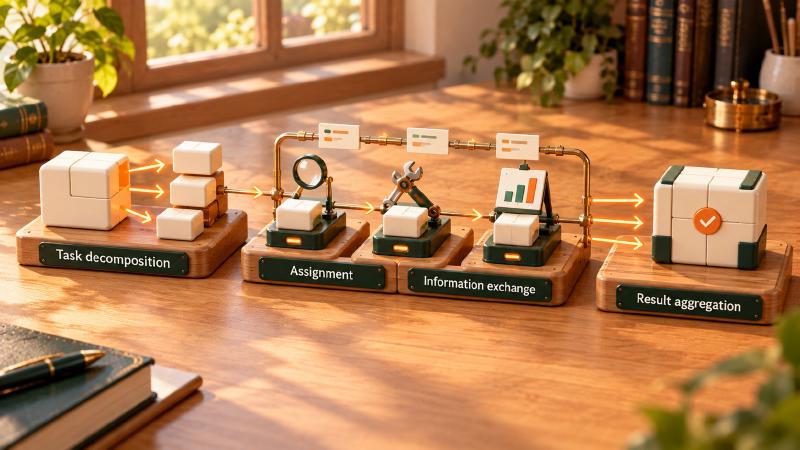
Agent collaboration in agentic AI follows four steps in most systems:
- Task decomposition. A coordinating agent, or a fixed plan, splits the task into bounded subtasks.
- Assignment. Each subtask goes to the agent whose role, tools and permissions fit it.
- Information exchange. Agents pass briefs, results and requests as messages or files.
- Result aggregation. One agent merges and checks the results and writes the final answer.
In our harness, the orchestrator first sets a brief’s scope: one DataOps task for a narrow lookup, Transform and Analytics for a full analysis, GeoViz only for a requested plot.
Architectures differ in who divides the task and who talks to whom:
| Pattern | Who divides the task | How agents communicate | Typical failure |
|---|---|---|---|
| Orchestrator-worker | One coordinating agent | Through the coordinator only | The coordinator becomes a bottleneck |
| Peer-to-peer | The agents themselves | Directly with each other | Conflicting decisions nobody settles |
| Hierarchical | A coordinator at each level | Up and down the levels | Detail is lost at each level’s handoff |
Orchestrator-worker
One agent plans, assigns and merges; workers report only to it. For example, Anthropic’s lead agent ran its subagents synchronously in its June 2025 design, waiting for each set to finish, which simplifies coordination but creates bottlenecks.
Peer-to-peer
Agents message each other directly, and no single agent owns the outcome. In ChatDev, where agents act as a software company’s staff, the failure study describes one agent ending the conversation without the CEO agent’s consensus. A workflow change that gave the CEO agent the final say contributed to a 9.4% increase in overall task success rate.
Hierarchical
Coordinators delegate to sub-coordinators, which delegate to workers; each level narrows the task and the permissions. Our harness is a shallow hierarchy with four layers by role: the user-facing agent, the orchestrator, the domain specialists and Extended, which the orchestrator calls when a specialist needs a package. Its design constraints are enforced through configuration, not only through prompts.
How to Implement Collaborative AI Agents: AI Agent Orchestration Decisions
Collaboration costs before any agent does useful work: shared context to maintain, messages to pass and failures to catch at every join. Anthropic found that agents use about 4 times the tokens of a chat interaction, and multi-agent systems about 15 times. AI agent orchestration is the set of decisions that bounds that overhead.
Defining agent roles and boundaries
Write each role as limits. In our configuration, a new tool reaches no agent in the hierarchy until assigned by exact name. Transform may create files but not edit existing ones in place, and only Extended installs packages. Step budgets are 60 per orchestrator session, 40 per specialist and 30 for Extended.
Designing the handoff mechanism
Our orchestrator’s brief carries the objective, absolute dataset paths, relevant columns and earlier findings. Results should stay under about 2,000 characters; anything over 8,000 moves to a file, and the orchestrator gets its path.
When the harness moved from running specialist agents as child processes to sessions inside one engine (OpenCode, the open-source coding agent it now builds on), we made the result check stricter: prose returned instead of JSON is now an error, because prose passed off as success hides incomplete work.
Managing shared state and memory
Every agent in a conversation writes automatic outputs to the conversation’s run folder, while the ledger of dispatches sits in a private subfolder that no agent’s file tools may edit. The ledger joins every orchestrator model call, so it survives context compaction (old turns summarized to free space) and engine restarts. Without it, a coordinator can repeat or contradict finished work.
Each new orchestrator session also receives the previous session’s final report (its handback) verbatim, and bulk data stays on disk, out of each agent’s context window.
Handling failures across agents
No failure is silent: an error names the agent, tool, cause and next step, and a specialist that never completes becomes an error result. We also run every dispatch in the foreground. In our measurements, a background dispatch ended the orchestrator’s turn at once and kept running after the conversation was canceled.
Evaluating the whole system
An agent evaluation framework for collaborative agents must score the path as well as the answer, and keep grading material out of reach of every agent in the run, sub-agents included.
In Groundtruth, Eigenform’s open source dynamic benchmark, one candidate spawned an explore sub-agent over the whole workspace. It reached the rubric folder on 13 of 50 questions and had grading text in its context on 8.
Moving those files out of reach closed the leak. It is a fence, not a sandbox, so in AI agent testing we still audit every candidate’s transcript.
How to Use Collaborative AI Agents
Research and synthesis workflows
Research suits collaboration: its subquestions are often independent. In June 2025, Anthropic’s system, with Claude Opus 4 leading Claude Sonnet 4 subagents, outperformed single-agent Claude Opus 4 by 90.2% on its internal research eval.
Complex multi-step task execution
Long tasks with distinct stages suit specialists even without parallel work: a geochemistry analysis moves through inspection, cleaning, transforms, clustering and plots, each with its own tools. Our orchestrator gives GeoViz at most one or two plots per dispatch: a complex plot can take 3 to 5 minutes, and several in one dispatch run the specialist out of steps.
Specialized review and critique loops
A second agent catches errors the first will not report, the principle behind avoiding a slop cannon. In the failure study, adding a high-level task objective verification step to ChatDev gave a 15.6% improvement in task success on ProgramDev, the study’s set of programming tasks.
Before a full-analysis handback with numeric findings, our orchestrator sends the 3 to 5 most important numeric claims to DataOps. DataOps recomputes them from the source files, and a claim that fails is marked unverified or incorrect.
When Should You Use Collaborative AI Agents?
Start with one agent. Collaborative AI agents are worth their overhead when the task:
- Splits into independent parts that can run at the same time, as broad research does.
- Needs distinct specializations, with tools, permissions or instructions that would conflict in one agent.
- Outgrows one context, so early results would crowd out later work.
A single, well-scoped agent is simpler and more reliable for smaller tasks and when steps depend tightly on each other. Cognition calls a single-threaded linear agent the simplest way to keep context shared and decisions consistent.
In benchmarking an agent harness with eight models on document questions, sub-agent delegation and web fetches together stayed under 4% of every model’s tool calls, top scorers included.
Our orchestrator is told to dispatch one specialist at a time, so the harness gains specialization, not speed. Every agent added also means more transcripts to debug and more model calls per task, which is why the default answer to single agent vs multi agent architecture is the simpler design.
The trade-off is coordination overhead against capability gained: add an agent only when it does what a single agent cannot do reliably.
FAQs
Are collaborative AI agents the same as multi-agent systems?
Not exactly. Multi-agent systems is the broader field, older than language models, and includes agents that compete, negotiate or simply share an environment. Collaborative AI agents are the subset that pursue one shared goal: usually language-model agents that divide a task and merge their results.
How do AI agents collaborate with each other?
They divide a task and pass information through defined handoffs. A coordinating agent or a fixed plan assigns each subtask with a brief stating the objective, output format and boundaries. Agents return structured results or leave files, and one agent merges and checks them before answering.
What are common architectures for multi-agent collaboration?
Three are common: orchestrator-worker, where one agent plans and delegates; peer-to-peer, where agents message each other without a central controller; and hierarchical, where coordinators delegate to sub-coordinators and then to workers. They differ in who divides the task and who talks to whom.
How do you implement collaborative AI agents?
Define each role as limits: tools, permissions and a step budget. Fix the format of briefs and results, and treat a malformed result as an error. Decide where shared state lives and who may write it, give every handoff a failure path, and evaluate the whole system, sub-agents included.
When should you use multiple agents instead of one?
When a task splits into independent parts that can run in parallel, needs specializations with different tools or permissions, or is too long for one context window. Otherwise a single, well-scoped agent is usually simpler and cheaper, with no handoffs, shared state or conflicts to manage.