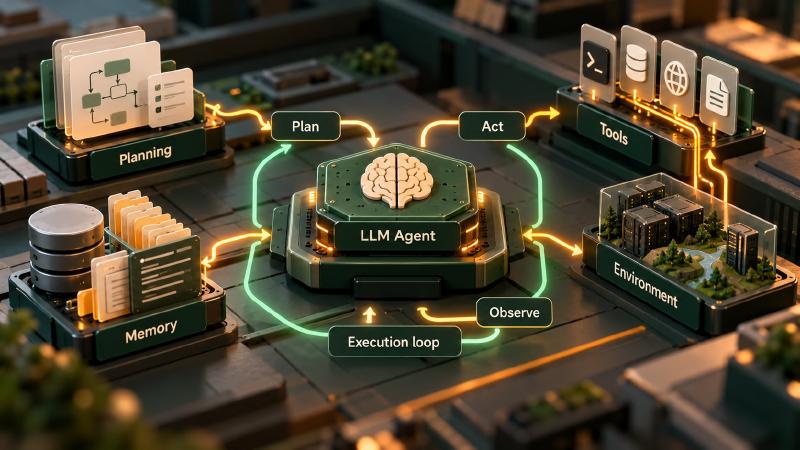
TL;DR
- LLM agent architecture is the arrangement of components around a language model, a planning layer, memory, tool access and a control loop that determines what an agent can do and where it breaks. How these parts are arranged and constrained matters more to reliability than which model sits at the centre.
- Common patterns are a single tool-using loop, a planner-executor split and multi-agent designs. Start with the simplest one and add structure only when a measured failure demands it.
Key Takeaways
- Four components recur. A planning layer, memory, tool access and an execution loop appear in nearly every design, and each has a typical failure.
- Single-agent and multi-agent designs solve different problems. One agent is simpler to reason about; several add coordination cost in exchange for specialisation and parallel work.
- Patterns trade simplicity against control. ReAct-style loops, planner-executor splits, and orchestrator-worker designs each fail in a different place.
- Choose by task, not by sophistication. Over-engineering a simple task adds failure modes without adding value.
Most descriptions of LLM agent architecture list what an agent has: a planner, a memory, some tools. A more useful description also lists what each part is not allowed to do, because the limits are where reliability comes from. An agent that can do everything can also fail everywhere.
We run a research harness built on this idea, and the examples below come from it and from benchmarking agents. This article covers general-purpose design patterns, not any one system, and it stays descriptive: for each component and pattern it names what the design is for and what breaks first.
What Is LLM Agent Architecture?
LLM agent architecture is the arrangement of components around a language model, namely planning, memory, tool access and a control loop, that determines what an agent can do and where it breaks. An agent-based LLM architecture fixes who decides each step and what each part is allowed to touch.
The distinction that matters most is who holds the control flow. In a workflow, code fixes the steps, and the model fills them in. In an agent, the model decides the next step itself. Architecture is the set of choices around that decision: what the model sees, what it can call, what it remembers, and when it must stop.
Architecture can be measured separately from the model. Eight models ran in the same harness with the same tools in our benchmark, and one made 67% of its tool calls in the shell while another made under 1%.
The surrounding system and the model produce behaviour together, and benchmarking an agent harness with the model held fixed is how the two are separated.
Key Components of LLM Agent Architecture: AI Agent Architecture Components
The four AI agent architecture components below assume the plan, act and observe loop described under LLM-powered autonomous agents. Each is described by its job, what breaks first, and the constraint that prevents it.
Planning/reasoning layer
The planning layer decides what to do next. It can choose one action at a time, or write a plan first and revise it. The best-known single-step form is ReAct, in which the model interleaves reasoning with actions so that each observation informs the next thought. What breaks first is plan drift: the agent keeps following a plan that the evidence has overtaken. The constraint is to let observations override the plan.
Memory (short-term and long-term)
Short-term memory is the context window; long-term memory is storage outside it, such as files or a database. What breaks first is the window filling with raw material. In our research harness, the agent’s instructions forbid loading data files into context, and tools return a schema, summary statistics and samples instead.
The principle behind it is keeping large datasets out of an AI agent’s context window, with the full data left in files the agent can query but never has to read in full.
Tool use and action execution
Tools are the only way an agent changes the world, so they are where most harm can happen. The model chooses a tool by its description, which makes the description part of the architecture.
What breaks first is ambiguity: two tools that look alike, or a tool that returns more than the model can use. The constraint is a small, distinct tool set per role, with names and results designed for the model reading them
Related: Designing MCP tools for real agents.
Execution loop and control flow
The loop decides when to continue, retry, hand off or stop. What breaks first is the loop that never ends: repeated failing actions, or work that drifts from the task. The loop is also where cost accumulates: in our benchmark, agents averaged between 9.6 and 19 tool calls per question across eight models.
The constraint is explicit limits on steps, time and spend, plus a defined way for the agent to report that it cannot finish. Control flow is also where the architecture records what happened, which makes it the foundation for observability.
Common LLM Agent Architecture Patterns, Including Multi-Agent LLM Architecture
LLM agent design patterns differ in where control sits and how much coordination they need.
| Pattern | Best for | What breaks first |
|---|---|---|
| Single-agent tool loop | Short tasks with a few tools | Context fills on long tasks |
| Planner-executor split | Tasks with a clear plan and many steps | The plan goes stale as results arrive |
| Orchestrator-worker | Tasks with separable parts needing different tools | Coordination cost and unclear ownership |
| Peer-to-peer | Tasks needing independent review or negotiation | Agents drift or defer to each other |
Single-agent, tool-using loop (ReAct-style)
One model, one set of tools, one loop. It is the easiest design to build, reason about and debug, because there is a single thread of decisions to read. It works until the task is long enough that early results crowd out later work, which is the point at which a second structure becomes worth its cost.
Planner-executor split
A planner writes the steps, and an executor carries them out, often with a smaller or cheaper model. The split keeps planning focused and execution cheap. It breaks when the plan is written without knowing what the tools return, so the executor needs a route to report back and trigger a revision.
Multi-agent architectures (orchestrator-worker, peer-to-peer)
In orchestrator-worker designs, a central agent breaks the task up and delegates parts to workers, each with a narrower job and often a narrower tool set. One concrete case is a four-layer research harness. The agent the user talks to can read data but cannot run shell commands or write files.
An orchestrator plans multi-step work and has no tool access at all. Specialists run as separate child processes, each limited to a slice of the tools, and one extended agent alone may install packages, and must record every install. Each rule exists because removing it caused a measured failure: prompt bloat, runaway context, dependency conflicts or agents bypassing the plan.
In peer-to-peer designs, agents exchange messages or critique each other with no central controller. This gives independent checks, and it is harder to control, because no single agent owns the outcome. It is the form that collaborative AI agents most often take.
All of these patterns assume the agent’s design is fixed. An agent that modifies its own prompts, memory or code adds an evaluator and a way to undo changes, a separate design problem covered under self-improving AI agent architecture.
How to Choose the Right LLM Agent Architecture: Single Agent vs Multi Agent Architecture
Single agent vs multi agent architecture is a question about the task, and the default answer is the simpler one. Anthropic’s guidance on building effective agents says the same: find the simplest solution that works, and add complexity only when needed, which may mean no agent at all.
| If the task… | Start with |
|---|---|
| Has steps known in advance | A fixed workflow, not an agent |
| Fits in one context and needs a few tools | A single tool-using agent |
| Has a clear plan and many routine steps | A planner-executor split |
| Has separable parts needing different tools | Orchestrator-worker |
| Needs independent review of its output | A second agent as checker |
Four questions sharpen the choice.
- Can the work run in parallel?
- Does any part need its own tool access or permissions?
- How easy must the system be to debug, since each added agent adds a thread to trace?
- And how much latency and cost can the task bear, since every handoff is another model call?
Climb one rung at a time: a single call, then a fixed workflow, then one agent, then a split, then several agents. Move up only when a measured failure on the simpler design justifies it. The four-layer harness above reached its structure that way, from specific failures and not from a template.
Best Practices for Building AI Agents
- Scope tool access tightly. An agent will search anywhere it can reach, so your AI agent can read its own answer key unless the files are out of reach. Restrict file access to a workspace, and set boundaries like those in trust boundaries for a local MCP server that reads your files.
- Design observability and evaluation in from the start. Log each step, and decide how success will be measured before the agent runs. A good AI agent evaluation framework scores the path as well as the answer, and it can only do that if the architecture records the path.
- Keep the architecture as simple as the task allows. Every extra agent, tool or memory adds a failure mode.
- Plan for failure. Give each step a timeout and a retry limit, and define what happens when the agent cannot complete the task. A clear failure result is better than a confident guess.
FAQs
What is the role of APIs in LLM agent architecture?
APIs allow an LLM agent to interact with external applications, databases, and services. They enable actions such as retrieving information, updating records, and triggering workflows. Authentication, input validation, and permission checks help ensure these interactions remain secure and controlled.
How does an LLM agent maintain context across multiple tasks?
An LLM agent can maintain context through conversation history, stored task state, summaries, and external memory systems. The application retrieves relevant information when needed and passes it to the model. This approach helps manage long-running tasks without including the entire interaction history in every request.
What security risks should developers consider when building LLM agents?
Key risks include prompt injection, unauthorized tool access, sensitive data exposure, and unintended actions. Developers should apply least-privilege permissions, validate tool inputs, isolate untrusted content, and require human approval for high-impact operations. Monitoring and audit logs also help detect and investigate suspicious behavior.
How do you evaluate the performance of an LLM agent?
Evaluate an agent using task completion rate, factual accuracy, tool-call success, response latency, and cost per completed task. Benchmarking against realistic tasks and expected outcomes helps identify weaknesses that may not appear in individual response checks. For a more structured evaluation approach, the GroundTruth Benchmark can be explored as a relevant resource for assessing agent performance.
Can an LLM agent work without external tools or a memory system?
Yes. An LLM agent can operate using only the model and an execution loop when the task relies on information available in its current context. External tools become useful when the agent needs real-time information or must perform actions, while memory helps with longer tasks or information that must persist across sessions.
How much does it cost to build and run an LLM agent?
The cost depends on model usage, the number of execution steps, external API fees, infrastructure, storage, and monitoring. Agents that repeatedly call models or tools can cost more than straightforward LLM applications. Developers can manage expenses through model selection, token limits, caching, and stopping conditions, while tracking cost per successful task.
What is the difference between an LLM agent and an AI chatbot?
An AI chatbot primarily responds to user messages, while an LLM agent can also take actions, use external tools, and continue working toward a goal across multiple steps. The distinction is not absolute: a chatbot can include agent capabilities, and an agent can communicate through a chat interface.
How can developers prevent an LLM agent from getting stuck in an execution loop?
Developers can set maximum iteration counts, execution timeouts, tool-call limits, and clear completion criteria. The system should detect repeated actions or unchanged results and stop or request human intervention when progress stalls. Logging each step makes it easier to identify the underlying cause.
How can LLM agents improve over time?
LLM agents can improve through evaluation feedback, error analysis, updated instructions, better tool selection, and refined workflows. Instead of relying on a model to improve automatically, developers can use task results to identify recurring failures and make targeted changes. Approaches to self-improving AI agents offer further context on how agent systems can use feedback and iterative refinement to improve their performance.