TL;DR
- Self-improving AI describes systems that take part in their own improvement: revising their outputs, rewriting their harness, training on data they generate, or running the research that produces the next model.
- By 2026 the demonstrated cases are real but narrow. Each closes a loop against a verifier a human specified, over a task a human chose.
- Compute is not what stands between these systems and open-ended self-improvement. No system yet picks its own research direction, and once a loop moves away from a formal verifier it degrades fast.
Key Takeaways
- Self-improving AI covers a spectrum of claims. Narrow assistance, automated research loops and full automation each rest on different evidence.
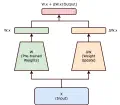
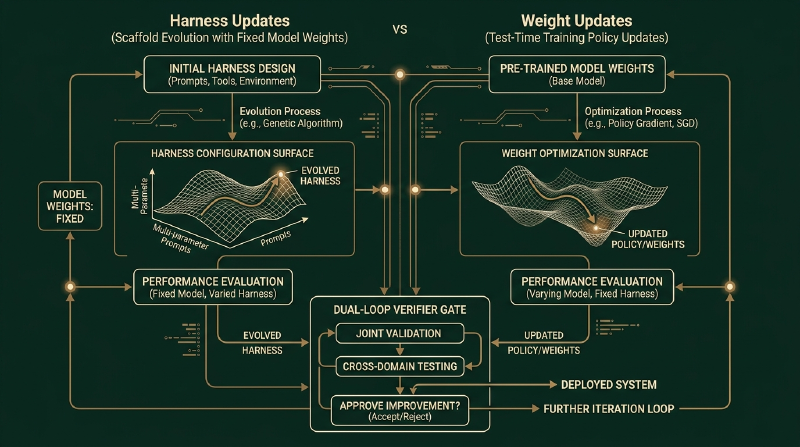
- Two research lines have run separately. Harness updates rewrite the scaffold and leave the weights alone; test-time training updates the weights and leaves the scaffold alone. SIA (arXiv:2605.27276) is among the first to close both in one loop.
- Self-improving AI is not self-learning AI. Self-learning usually means unsupervised learning from unlabelled data, which is a training method rather than a loop. The two get conflated constantly.
- Every demonstrated result is bounded by its verifier. Formal verifiers hold. Learned judges drift. Intrinsic self-assessment produces loops that confirm themselves.
- Improvement is showing up on four surfaces: code and algorithms, hardware, data curation, and the division of labour between systems.
- The rung humans still hold is research direction. Every system on this list is handed its problem by a person.
- Progress in 2026 is real but incremental. The honest reading is compounding narrow wins, well short of takeoff.
This is an evidence audit of self-improving AI: what the term means, which loops have actually been closed by 2026, and what would count as proof that a system improved itself.
What is self-improving AI?
Self-improving AI is any system that changes part of how it produces results, using what it learns while running, and checks whether the change was an improvement before keeping it. The change can land on the outputs, the harness around the model, the weights, or the pipeline that trains the next model.
The spectrum, from narrow assistance to full automation
At one end, a model reflects on a failed attempt and rewrites the next one. In the middle sits a closed loop: propose a change, test it against a verifier, keep it or roll it back, repeat; the components behind that loop are the subject of our piece on self-improving AI agent architecture. At the far end, a system would set its own research agenda and carry it out. Only the first two have been built. “Self-improving AI” is used for all three, which is why an evidence audit has to say which rung a given result sits on. Most of what follows is the middle rung.
What Is the Difference Between Self-Improving AI and Self-Learning AI?
The two terms get used interchangeably, though they do not describe the same thing. Self-learning AI (also written self learning AI, or AI self learning) almost always means a model picking up structure from unlabelled data with no explicit targets, which describes how a model is trained. Self improvement AI, or self-improving AI, is about the loop the deployed system runs on itself: what it may change, and what tells it the change worked. A model trained with self-learning methods can sit in production for a year and never improve itself; a self-improving system can run on top of a model trained any way at all. Search for either phrase and the same handful of papers comes up, which is part of why the distinction is worth stating plainly.
What has actually been demonstrated in 2026
The clearest way to read the evidence is by what the system modifies.
Outputs
STaR (arXiv:2203.14465) has a model generate reasoning chains, keep the ones that reach a correct answer, and fine-tune on that filtered set, then repeat. The loop is real and it compounds. It also needs a checkable answer for every training problem, which most real tasks do not supply. Self-rewarding models push on the same limit from the other side: the model produces its own preference labels and trains on them, which removes the need for a human labeller but moves the check inside the system being checked. The AI improvement here is real, and like every case on this list it is capped by one thing: the strength of the check.
The harness, and harness updates versus weight updates
A self-improving coding agent, SICA (arXiv:2504.15228), edits its own codebase and raised its score on a subset of SWE-bench Verified from 17 to 53 per cent. AlphaEvolve (Google DeepMind, 2025) runs a model inside an evolutionary loop with an automatic evaluator and found faster procedures for matrix multiplication and data-centre scheduling.
ADAS (arXiv:2408.08435) works a level higher: a meta agent writes new agent programs and keeps the best in a growing archive. The Darwin Gödel Machine (arXiv:2505.22954) edits the logic it uses to decide how to edit itself, validates each change against a benchmark, and moved its own SWE-bench score from 20 to 50 per cent. Its name traces back to the Gödel Machine proposed by Jürgen Schmidhuber, a hypothetical self-improving AI that would rewrite itself only after proving the change helps; the Darwin version replaces proof with empirical testing. In all four the weights never change; only the scaffold does.
The other line is test-time training, a form of continual learning: the harness stays fixed and the model is updated on the task in front of it, usually through a reinforcement-learning or preference pipeline. These two lines ran separately until SIA (arXiv:2605.27276), which puts a feedback agent in charge of deciding, each iteration, whether to rewrite the scaffold or update the weights. It was tested across legal charge classification, GPU kernel optimisation and single-cell RNA denoising, which is a wider spread of domains than the harness-only or weights-only work. Telling the two kinds of gain apart on a leaderboard takes care; benchmarking a harness with the model held fixed is one way to separate them.
Hardware and data curation
AlphaEvolve’s scheduling and circuit-design results are the hardware surface: the same loop, pointed at infrastructure rather than model code. On the data side, the DARWIN natural-science models (arXiv:2308.13565) were trained on instruction data a model generated from scientific text, rather than data written or curated by hand. In both cases the system improves the inputs to the next training run and leaves the run itself untouched.
The division of labour, and the fact that this is now taught
The newest surface is systems handing work to other systems: an orchestrator that routes a task to a specialist, a research loop that drafts, critiques and revises across several models, a multi-agent setup where one agent’s job is to decide what the others do next. None of these has produced a headline result on its own yet, but they are where several groups are now pointing the loop, on the bet that the next gains come from how the work is divided among systems, more than from any single model getting smarter.
The field has formalised enough that Stanford now runs a graduate seminar on it, CS329A, Self-Improving AI Agents, first taught in 2025. A seminar is not a research result, but it marks the point where the techniques settled into something teachable, past the stage of scattered one-off demos.
AI recursive self-improvement: the state of the loop in 2026
Recursive self-improvement is the case where improvement feeds back on itself: each cycle sharpens the process that produces the next one. None of the systems above do that in the open-ended sense. Each closes a bounded loop inside an objective a person set.
Progress on AI recursive self-improvement through 2026 has been steady: SWE-bench numbers climbing a rung at a time, evolutionary loops turning up genuine algorithmic wins, more domains pulled inside a working loop. Every one of those gains has stayed inside its verifier. An August 2026 study led by Princeton researchers, reported by MIT Technology Review, found the same gap from another angle: AI agents could handle the engineering side of AI research but lacked the judgment to produce original research at the level of a top machine-learning conference.
What keeps the loop closed
Four things keep the loop closed, and the first two, a trustworthy check and contact with the world, are the same signal problem that makes RSI hard outside curated settings:
- Verification. The strength of the check sets the ceiling. Formal verifiers hold their ground. Executable tests are close behind, as long as the agent cannot read its own answer key. Learned judge models drift, which is why we test the rubric before we test the model, and a loop supervised only by the model’s own assessment tends to confirm whatever it already believes.
- Grounding. A loop needs contact with something outside the model. Trained round after round on its own output with no external anchor, a model narrows toward a degenerate distribution.
- Compute. Evaluating enough candidates to make a search worthwhile is expensive. Automatic evaluators exist in this work because a human checking each candidate would make the loop too slow to run.
- Direction. Every system here is handed its problem. None decides what to work on next. That is the rung where humans still sit.
The co-improvement counter-position
Not everyone agrees that closing this loop should be the goal. Jason Weston and Jakob Foerster argue in AI & Human Co-Improvement for Safer Co-Superintelligence (arXiv:2512.05356) for “co-improvement”: AI systems built to work alongside human researchers through the whole research cycle, rather than to improve themselves alone. They present it as both faster and safer. It is the most substantive live disagreement in the field, and it turns the “direction” rung above from a gap into a design choice.
What would count as evidence
A benchmark number going up is weak evidence that a system improved itself, a point that runs through AI agent evaluation generally, because the number can rise for reasons that have nothing to do with the loop. Three things we hold to in our own work:
- A falsifiable claim. State what result would count against the method, not only what counts for it. In Machine Learnability as a Measure of Order (arXiv:2509.18103) the whole method is a measurement designed to be checked: how much learnable structure a model can extract from a sequence, reported with confidence intervals, comparable across conditions.
- A check the model cannot argue its way past. Generalising from Self-Produced Data (arXiv:2504.04711) validates a candidate behaviour by running it and seeing whether it holds up, not by comparing its wording to a reference. The check does not depend on the model’s own judgement.
- The environment as the reward signal. In Survival is the Only Reward (arXiv:2601.12310) a behaviour survives only if its effect on a real environment persists and leaves the agent able to keep acting. There is no rubric and no score to game; the environment either sustains the behaviour or it does not.
These are narrow loops too. What matters to us is where a self-improving AI agent anchors its loop: to a signal from the world, or to the model’s own account of its work. We build for the first.
Conclusion
Self-improving AI is real, and it is narrow. Loops that revise outputs, rewrite harnesses, curate data and split work between systems have all been closed, and each one is bounded by a verifier and a task a person chose. What has not been shown is a system that picks its own research direction and keeps improving outside that frame. Until it is, the useful question about any claim is which rung it sits on, and what checks the loop.
FAQs
What does self-improving AI mean?
A system that changes part of how it works, using what it learns while running, and checks the change against some signal before keeping it. The change can be to its outputs, its harness, its weights, or the data that trains the next model.
Does self-improving AI exist yet?
Narrow versions do. Systems like STaR, SICA, AlphaEvolve and the Darwin Gödel Machine close a real loop and improve on a benchmark. Open-ended self-improvement, where a system sets its own goals and compounds without limit, has not been shown.
What is the difference between self-improving and self-learning AI?
Self-learning usually means training a model on unlabelled data with no explicit targets. Self-improving means a loop the deployed system runs on itself: it changes something about how it works and verifies the result. One is a training method, the other is a feedback loop.
What is recursive self-improvement in AI?
The case where the improvement compounds: each cycle makes the next cycle more effective, so the system gets better at improving. Today’s systems approximate this inside a fixed objective and verifier. The unbounded version is a projection, not an observed result.
Can AI improve itself without humans?
Only inside limits a human set. Every demonstrated system is given its task and its verifier by a person, and runs in an environment a person built. Removing the human from the loop entirely, including from choosing what to improve, has not been done.
Is self-improvement still the right goal for AI research?
Not everyone thinks so. Jason Weston and Jakob Foerster argue for co-improvement instead: AI systems designed to work with human researchers across the whole research cycle, rather than improve themselves alone. They see it as faster and safer. The disagreement is live, and most demonstrated systems today already keep a human choosing the problem.
Why do some researchers think recursive self-improvement is further away than the industry suggests?
Because the demonstrated loops all stay inside a verifier and a task a person set. A 2026 study led by Princeton researchers found AI agents could do the engineering of AI research but lacked the judgment to produce original, conference-level research. Open-ended research is the step no system has shown yet.
Where did the idea of a self-improving Gödel Machine come from?
From Jürgen Schmidhuber, who proposed the Gödel Machine decades ago as a hypothetical AI that rewrites its own code once it can prove the change is an improvement. Sakana AI’s Darwin Gödel Machine borrows the idea but replaces formal proof with empirical testing on a benchmark, keeping changes that measurably help.