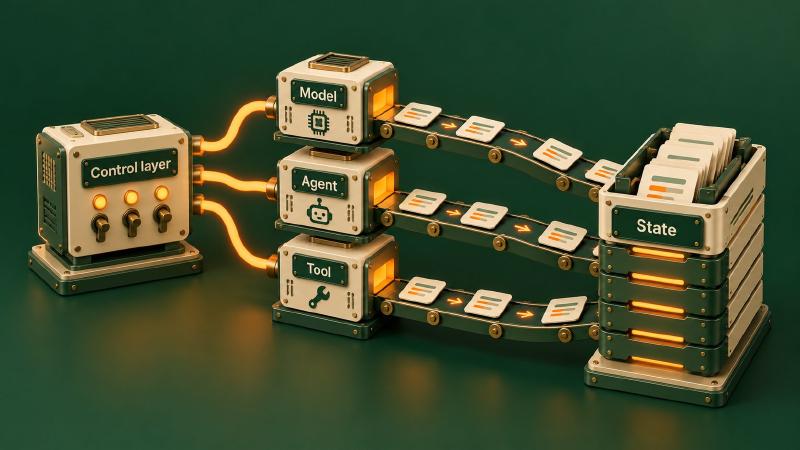
TL;DR
- AI orchestration coordinates multiple models, agents, tools and data sources into a single working system, deciding what runs when, in what order, and how results get passed between components.
- It becomes necessary once an AI system grows past a single model call, when something has to manage sequencing, state and failure handling across the pieces.
Key Takeaways
- Orchestration coordinates components, it doesn’t add intelligence on its own. It manages sequencing, routing and state between models, agents and tools rather than performing tasks itself.
- Core components recur across most orchestration setups. A control/routing layer, state management, and integration with underlying models and tools show up in nearly every design.
- Frameworks differ mainly in how much structure they impose. Some favor rigid, predefined workflows; others favor more dynamic, agent-driven routing; the right choice depends on how predictable the task is.
- Implementation should start from the workflow, not the tooling. Mapping out what needs to happen, in what order, and where failures can occur comes before picking an orchestration framework.
What is AI orchestration, and when does a team need it? A single model call needs none. The need appears when a task takes several steps, uses several tools, or runs long enough that something has to track progress and handle a failed step.
We use orchestration in two places at Eigenform. In the Geocluster Research Harness, our open-source workbench for geological data analysis, an orchestrator agent hands each analysis step to a specialist. Our benchmark-building pipeline, by contrast, is a fixed workflow with scripted checks.
What Is AI Orchestration?
AI orchestration is the coordination of multiple models, agents, tools and data sources into one working system. It decides what runs when and in what order, passes results between components, keeps track of state, and handles failures, so a multi-step task completes without a person managing each step.
Orchestration does not add intelligence by itself. The models and tools do the work, and the orchestrator sequences them, the way a conductor leads without playing an instrument. For example, the orchestrator in our harness plans and routes an analysis but has no data tools of its own; the specialists it dispatches do the work.
AI orchestration vs automation is a common confusion. Automation executes a defined task or rule, such as sending a report every Monday. Orchestration coordinates several components, some of them automated, and chooses between them as the task unfolds. With a model in the loop, it must also handle output that is late, malformed or wrong.
How Does AI Orchestration Work? AI Workflow Orchestration Step by Step
AI workflow orchestration follows the same loop in most systems:
- A request or task arrives.
- A control layer decides which model, agent or tool handles the first step.
- That component runs and returns a result.
- The orchestrator stores the result or passes it on, and updates its record of state.
- It decides the next step (another component, a retry, a fallback or completion) and repeats until the task is done.
A geological data analysis shows why the loop matters. It runs in steps: load, check quality, clean, transform, cluster, plot and verify. In a single agent conversation, the context fills with column statistics, previews and logs long before the analysis finishes.
Our harness therefore runs specialist agents as child processes. Each specialist starts with only its task and returns one short structured result. In a normal run, the orchestrator sees only that result, not the specialist’s tool calls or logs, and decides the next step from it.
Key Components of AI Orchestration: What Is AI Agent Orchestration Made Of?
Most orchestration designs share four components: a routing or control layer, state and memory management, integrations, and error handling. The first three show up in nearly every design, from a two-step pipeline to a team of agents.
What is AI agent orchestration, then? It is the case where the coordinated parts are agents: models that reason and call tools on their own. It uses the same four components, but a model decides more of the routing, so each component has more to contain.
Routing / control layer
The control layer decides which component handles each step and what happens after it returns, through fixed rules or a model’s choice. Picking the model or tool for one request is AI routing, a single decision inside this layer.
Multi-agent coordination, where collaborative AI agents hand work to one another, is one specific case of orchestration. There, the control layer also decides who may hand work to whom. In our harness, activate_specialist switches the system prompt within one conversation, while dispatch_specialist starts a separate child process, and only the orchestrator can call it.
State and memory management
State is the orchestrator’s record of what has been done, what each step returned and what remains. It is not the model’s context window (the text a model takes in per request), and keeping the two apart is a design decision.
Our orchestrator’s prompt lists the last 20 dispatches with their objective, status and duration, so the record survives when the conversation is compacted. The harness caps results at 8,000 characters, and anything larger goes to a file whose path the orchestrator receives, the same rule we use to keep large datasets out of an agent’s context window.
Integration with models, agents and external tools
The orchestrator needs a consistent way to reach model APIs, other agents, databases and services. A standard protocol such as MCP (Model Context Protocol) cuts custom connector work. In our harness, every child process connects to the same local MCP server as its parent, and tests pin which tools each specialist may call.
However, reach is not enough. Many MCP hosts pass the model only a result’s text, so our MCP tool design now repeats in that text anything an agent must not guess.
Written instructions then add procedure to that reach, the core of Agent Skills vs MCP: MCP gives an agent access to a system, and a Skill tells it how to do one kind of task.
Error handling and fallback logic
Every step can fail, time out or return something unusable. The orchestrator therefore needs timeouts, retries, a reliable failure signal and a fallback. Three habits from our systems apply generally:
- Detect failure from structure, not text. Our harness once flagged a timeout whenever “Command timed out” appeared in a child’s output, which also happened when a script inside a healthy child timed out. It now reads a flag from the process runner.
- Return failures as failures. A failed step reaches the orchestrator as a tool error, not an ordinary result, which is harder for a model to talk past.
- Prefer a gap to a guess. Our benchmark’s grader is an LLM judge that cannot invent a score: after three replies that break its output rules, the question stays unscored.
Types of AI Orchestration Frameworks: What Is AI Orchestration Platform Software?
AI orchestration tools range from code libraries to managed platforms. What is AI orchestration platform software? It is a managed product that bundles the components above: a workflow or agent engine, connectors, state storage, monitoring and access controls. A framework, by contrast, is a library you build with and run yourself.
Either way, frameworks differ mainly in how much structure they impose:
| Aspect | Predefined / workflow-based | Dynamic / agent-driven |
|---|---|---|
| Control flow | A fixed sequence or graph, set at design time | A model chooses the next step at run time |
| Predictability | High: the same input follows the same path | Lower: paths vary between runs |
| Testing | Each step and check can be tested directly | Needs evaluation across many runs |
| Typical fit | Repeatable processes with known steps | Open-ended tasks whose steps depend on what is found |
| Our example | The benchmark-building pipeline | The Geocluster Research Harness |
Predefined / workflow-based orchestration
The steps and their order are fixed in advance, with branches for failures. This fits a task that is the same every time.
Our pipeline for a custom LLM benchmark works this way. One fixed prompt turns source documents into 50 questions with reference answers and grading rules. It stops once, for a person to approve a blueprint, and each stage must pass a scripted check (four in all) before the run moves on.
Every benchmark in Groundtruth, Eigenform’s open source dynamic benchmark for testing models, is now built this way. Mainly the documents change.
Dynamic / agent-driven orchestration
A model decides which component to call and when to stop. This suits tasks whose steps depend on what is found, such as a data analysis. The cost is variability, which the rest of the system has to contain.
The Geocluster Research Harness contains it with fixed permissions per layer. The user-facing agent cannot run a shell or write files, specialists get filtered tool sets, and only one extended agent may install packages. Tests enforce each rule, and each exists because breaking it caused a measured failure, such as runaway context.
When Do Organizations Need AI Orchestration?
What is AI orchestration worth to a team that only ever makes one model call? Very little. Summarizing a document or classifying a ticket is one call with one result. Coordination logic becomes unavoidable when any of these hold:
- Multiple steps, each depending on the output of the last.
- Multiple tools or data sources that must be called in a sensible order.
- Multiple models or agents, each suited to part of the task.
- Long-running work that must survive a failure partway through.
- Human approval points, where the system must stop and later resume.
Splitting work also helps reliability. A short task fails less often than a long one, and an agent that needs another’s output notices when it is missing, where a single agent might invent it. That is the first of our principles for avoiding a slop cannon, a pipeline that produces fluent output with no way to catch its own errors.
The price is more components, failure modes and model requests, so a task that fits in one well-written call is better left alone.
How Can You Implement AI Orchestration?
Implementation comes down to four decisions, best taken in this order.
Mapping the workflow before choosing tooling
List the steps, what each takes in and returns, where it can fail, and where a person must decide. Do it before choosing a framework or running anything.
On one benchmark build, 9 of the last 22 questions collided with questions already written, because an early section had used up the best evidence. Allocating all 50 in a blueprint before drafting now prevents that. A workflow map does the same for any orchestrated system: it shows conflicts while they are cheap to fix.
Choosing a framework fit for how predictable the task is
If the steps are known, use a predefined workflow and keep each step testable. If they depend on what the system finds, use agent-driven routing and bound it with limits on steps, time and cost. Enforce those limits in code where you can, since a model can ignore its instructions.
Hybrids are common. Inside our agent-driven research harness, one path is fixed: a specialist that needs a missing Python package must return a structured request instead of installing it. The orchestrator dispatches the extended agent to install it, then re-dispatches the specialist, which resumes where it stopped.
Designing for failure: fallback and retry logic
Give every step a timeout, a retry limit and a fallback. Each dispatch in our harness has 600 seconds. The harness stops a child that runs out of time and hands the orchestrator an error suggesting smaller tasks.
Separate retries by failure type. Our grader gives a request up to four attempts when the network fails, waiting 2, 4 and then 8 seconds between them, separately from the three attempts it allows for a malformed reply.
Define stop conditions too. Our dynamic benchmarking pipeline stops early for exactly two reasons. Either the documents cannot support 50 defensible questions, and it reports how many they can, or the session is nearly out of capacity, and it saves its state. It never lowers quality to finish.
Monitoring the orchestrated system, not just individual components
Log every step with its input, output, duration and cost. Our harness shows each child process’s status, duration, tokens and cost in the chat, and adds that cost to the task’s total.
Then evaluate the whole system, giving every component the rigor you would give a single agent. AI agent evaluation scores reasoning, tool use, the path taken and the end result, because a run can fail at any step and still end fluently.
Attribution is the hard part. In our benchmark, eight models ran in the same harness with identical tools, yet one made 67% of its tool calls in the shell and another under 1%. A score belongs to a model and its harness together, so benchmarking an agent harness means holding the model fixed.
Finally, read results against the resolution of the benchmark. On our 50-question sets, a gap smaller than 0.27 to 0.45 points out of 10, depending on the set, is within the noise.
FAQs
What is AI orchestration used for?
AI orchestration is used wherever an AI task needs several coordinated steps. Examples include research agents that hand each analysis step to a specialist, document pipelines that extract, check and summarize, and support flows that classify a request, look up records, draft a reply and escalate to a person.
What is the difference between AI orchestration and AI agent orchestration?
AI orchestration is the broad term for coordinating any mix of models, tools and data sources, including fixed pipelines. AI agent orchestration is the subset where the coordinated parts are agents that reason and act with some autonomy, so the orchestrator also manages handoffs between agents, shared state and limits on what each agent may do.
What is an AI orchestration platform?
An AI orchestration platform is a managed product that bundles a workflow or agent engine, connectors to models and tools, state storage, monitoring and access controls. It reduces setup work compared with building on a framework library, at the cost of vendor dependence and less control over its internals.
What are the core components of AI orchestration?
Most designs have four: a routing or control layer that decides what runs next, state and memory management that records progress, integrations with models, agents and external tools, and error handling with fallback logic. Monitoring across the whole system ties them together and shows where a workflow breaks.
When does an organization need AI orchestration?
When a task goes beyond one model call: it has several dependent steps, uses multiple tools or models, runs long enough to need recovery from failure, or needs human approval partway through. A single prompt-and-response task does not need it, and adding orchestration there only adds components that can fail.