What the Navier–Stokes Millennium Prize problem is
The Navier–Stokes equations are the standard mathematical description of how fluids move: air over a wing, water in a pipe, weather systems, blood flow. They have been used for about 170 years and work extraordinarily well in practice. What they do not come with is a proof that, in three dimensions, a smooth initial flow stays smooth forever. It is possible, in principle, that the equations themselves predict that velocities become infinite in finite time—a “blow-up” or singularity.
What OpenAI and the Buckmaster–Alpöge team announced
In 2000 the Clay Mathematics Institute listed this as one of seven Millennium Prize Problems, each carrying a $1 million prize and on 8 September 2026 two announcements about advances towards a solution arrived within hours of each other.
Tristan Buckmaster (NYU) and Levent Alpöge (a mathematician at Anthropic, working in a personal capacity) posted results, with formalizations showing finite-time blow-up with smooth forcing for several related systems. Experts, including Terence Tao, treated this as a major advance that made a full Navier–Stokes result look newly plausible. They had used large language models, including OpenAI tools, as research assistants. Later the same day OpenAI announced that an unreleased internal model, coordinating roughly 10,000 agents for about 88 hours at a cost the company put in the millions of dollars, had produced a proof that the three-dimensional Navier–Stokes equations themselves can develop a singularity in finite time.
The dispute over who solved it first
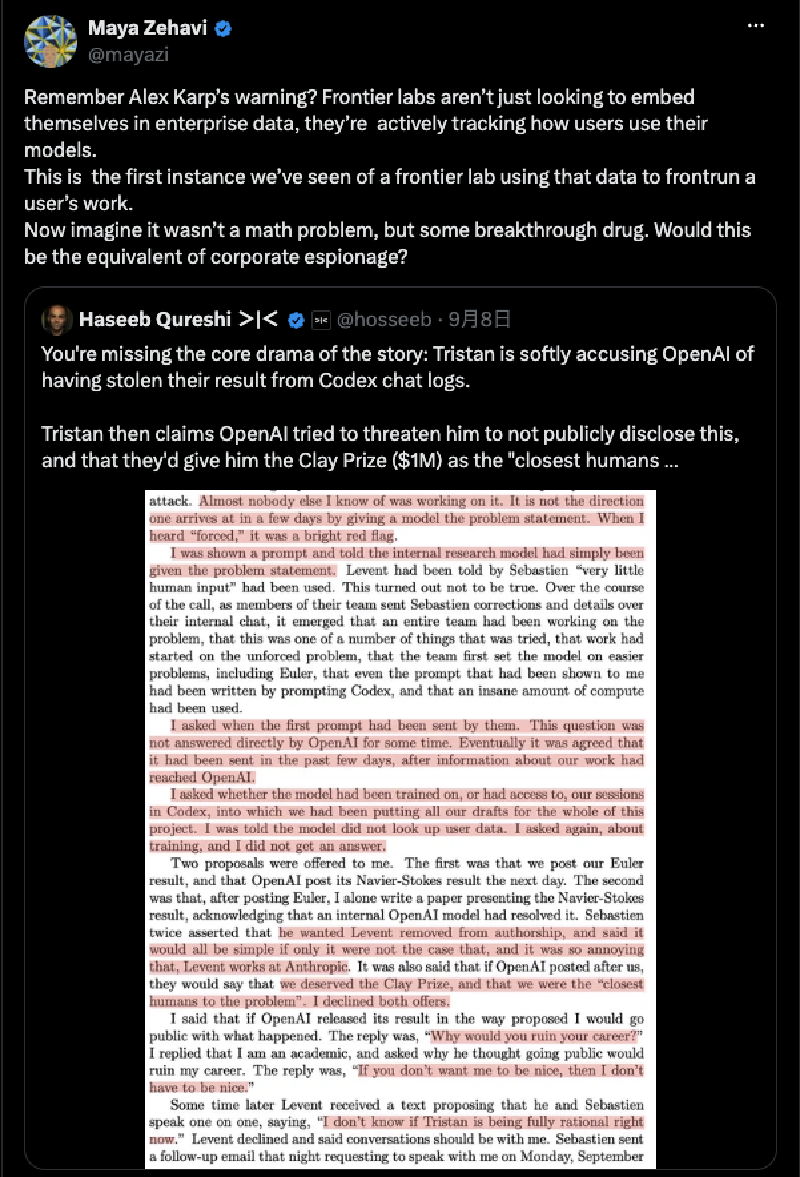
This itself caused a major blow-up within the world of people who care about these things. Buckmaster says he and Alpöge had been following a specific line of attack for months, depositing drafts in OpenAI’s Codex product; that OpenAI only mounted its enormous computational effort after rumours of their progress reached the company; that the eventual Navier–Stokes argument used a closely related route; and that in private calls OpenAI researcher Sébastien Bubeck discussed publication arrangements that would have excluded Alpöge (because he works at a competitor) and threatened to destroy Buckmaster’s career. Buckmaster’s open letter hints that he believes OpenAI to have used his Codex data. OpenAI insists that it found its own solution independently, though its models may possibly have trained on Buckmaster and Alpöge’s chats.
Why this matters if you research with AI
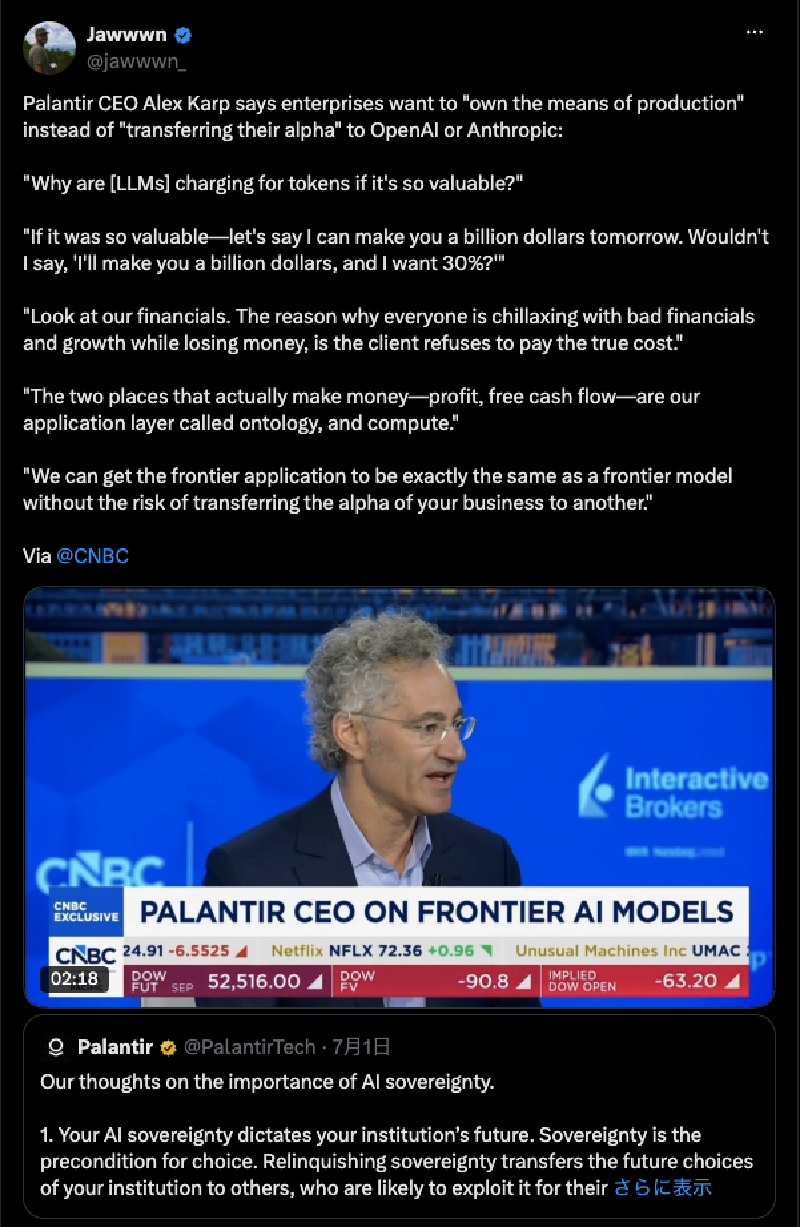
The dispute places the possibility of major AI companies reading or training on independent researchers’ interactions with their products, and effectively front-running new discoveries. The suspicion has hung heavy in the air ever since Anthropic announced its intention to enter the bio-medical space - with many commentators cynically suggesting that they were simply planning to read other researchers’ chats and use their own resources to beat them to market (in case Anthropic’s lawyers are reading this: this is Alex Karp’s suggestion, not ours).
Now similar suspicions are dogging OpenAI.
What this means for researchers using AI
The result is that researchers are going to have to be a lot more cagey when sharing their work, both with subscription-based AIs and also colleagues liable to reshare with their own AIs.
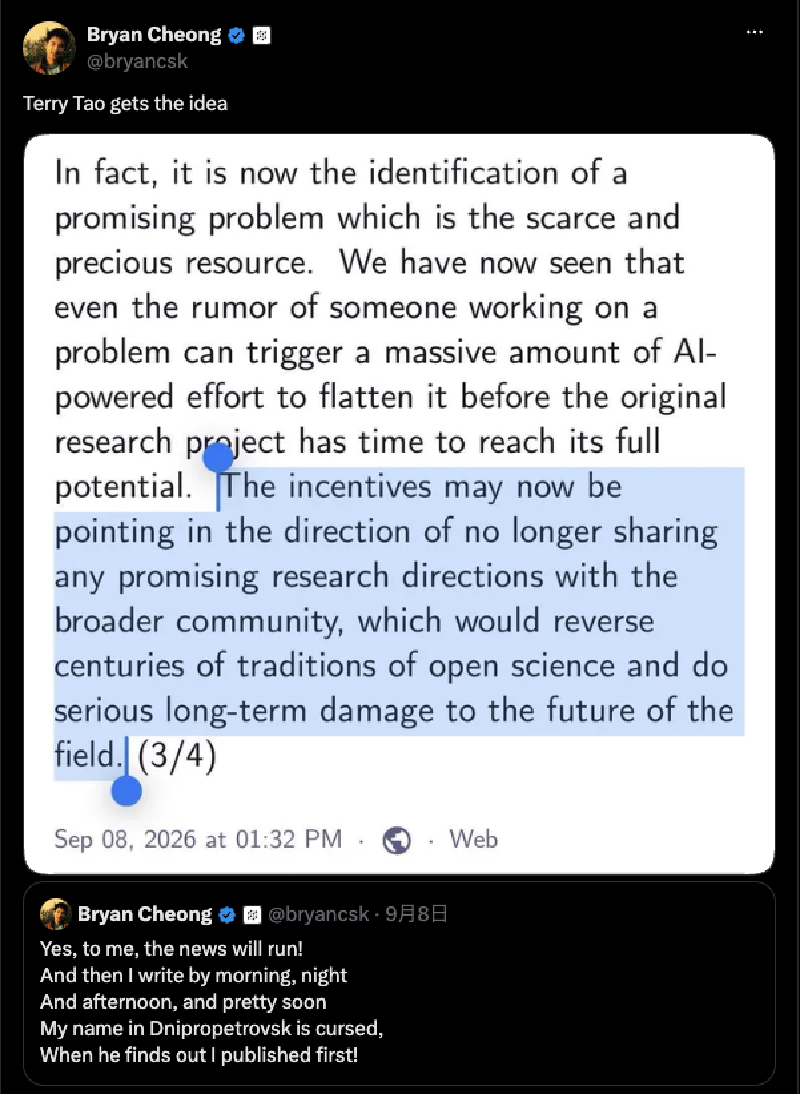
If you are doing cutting edge research with the aid of Claude, GPT or any other remote model, you will need to be prepared for the risk that - whether via the deliberate searching of user chats for lucrative ideas or via internal training on user conversations - your breakthrough is no longer entirely your own.
The case for local, self-improving research models
This is why we are betting on agile, self-improving local models that learn your research domain as they help you study it. If you want to get your own, get in touch: ops@eigenform.ai.