Key Takeaways
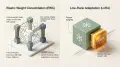
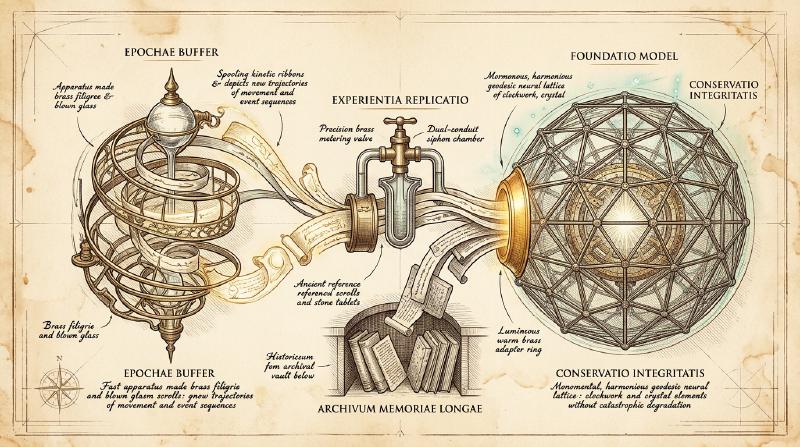
- The dual-memory architecture: Mitigating experience replay catastrophic forgetting llm risks requires operationalizing Complementary Learning Systems (CLS), interleaving fast episodic task acquisition with slow consolidation of prior knowledge.
- Root causes of representation collapse: Fine-tuning low-rank adapters exclusively on specialized domain trajectories can sometimes create directional gradient interference, overriding foundational reasoning, prompt comprehension, and code syntax.
- Rehearsal buffer mixing ratios: Interleaving a modest 10% rehearsal buffer from pre-cutoff general datasets helps prevent representational drift, maintaining benchmarks without diluting domain adaptation velocity.
TL;DR
When developers continually fine-tune language models on specialized tasks, parameter updates rapidly overwrite foundational knowledge. Understanding experience replay catastrophic forgetting llm dynamics requires looking at how biological memory stabilizes learning across shifting environments. Drawing on complementary learning systems continual learning theory, experience replay interleaves new environmental trajectories with historical or pre-training distributions. While most LoRA finetunes do not require a rehearsal buffer, if the LoRA data creates directional gradient interference it can still result in catastrophic forgetting. In this case injecting a small ratio (around 10%) of general rehearsal data across virtual epochs bounds gradient drift. Consequently, the model preserves baseline reasoning while acquiring aggressive, highly optimized domain capabilities.
Experience Replay Catastrophic Forgetting LLM Dynamics
Standard fine-tuning updates model weights along the steepest descent direction for the current task loss:
$$\theta_{t+1} = \theta_t -\eta \nabla_\theta \mathcal{L}_{\text{task}}(\theta_t)$$However, gradients computed exclusively on narrow domain tasks rarely align with the broad parameter manifold established during pre-training. Specifically, optimization steps on specialized data exert high directional pressure on self-attention projections and feed-forward intermediate layers. As a result, the model’s conditional probability distribution shifts dramatically, causing foundational skills (such as arithmetic logic, conversational coherence, and general programming syntax) to deteriorate within a few hundred gradient steps.
Consequently, replay buffers can provide the necessary counterbalance to the effects of rapid domain specialization. Instead of feeding batches drawn solely from the active task distribution \(\mathcal{D}_{\text{new}}\), the training loop draws from an amalgamated distribution:
$$\mathcal{D}_{\text{mixed}} = (1-\alpha) \mathcal{D}_{\text{new}} + \alpha \mathcal{D}_{\text{rehearsal}}$$Here, \(\alpha \in (0,1)\) governs the rehearsal mixing ratio. Because the loss is evaluated across both distributions simultaneously, gradients computed on the rehearsal data apply counter-directional forces that penalize parameter deviations destructive to prior knowledge. Ultimately, mitigating catastrophic forgetting without ballooning memory costs remains a challenge.
| Adaptation Strategy | Training Distribution | Parameter Drift Risk | Memory Overhead | Serving Flexibility |
|---|---|---|---|---|
| Vanilla SFT | Current task only (\(\mathcal{D}_{\text{new}}\)) | Severe (rapid forgetting of baseline reasoning) | None | High (single checkpoint) |
| Parameter Freezing | Base frozen, task heads updated | Low (base preserved, but capacity limited) | Moderate | Moderate (multiple heads) |
| Elastic Weight Consolidation | Current task with Fisher penalty | Moderate (diagonal Fisher decays over tasks) | High (\(O(N)\) Fisher matrix storage) | High (single checkpoint) |
| LoRA Rehearsal Replay | \(\mathcal{D}_{\text{new}} + \text{Rehearsal Buffer}\) | Minimal (regularized gradient trajectory) | Low (compact text buffer + low-rank weights) | High (swappable adapters) |
Experience Replay and Other Complementary Fine Tuning Systems
To understand why experience replay works so reliably, machine learning researchers frequently turn to cognitive neuroscience. In particular, the foundational framework of complementary learning systems continual learning theory, originally formulated by McClelland, McNaughton, and O’Reilly in 1995, explains how mammalian brains resolve this exact trade-off.
Fast Episodic Memory Versus Slow Neocortical Consolidation
In biological cognition, an organism cannot afford to write every fleeting experience directly into permanent cortical structures. Doing so would overwrite established concepts, and catastrophic interference would destroy long-term memory. Instead, the brain separates memory acquisition into two complementary systems:
- The Hippocampus (Fast Episodic Learner): A plastic structure capable of rapidly binding distinct sensory inputs into episodic traces with high learning rates. Consequently, it acts as an autobiographical scratchpad that records recent experiences without altering global semantic representations.
- The Neocortex (Slow Structured Consolidator): An extensive neural network that extracts statistical regularities, general concepts, and invariant world models across prolonged timescales using small, conservative synaptic modifications.
- System Consolidation (Offline Replay): During sleep and resting states, the hippocampus spontaneously replays stored episodic traces back to the neocortex. Furthermore, this interleaved replay allows the neocortex to integrate new insights alongside older knowledge without destabilizing established cognitive attractors.
Accordingly, applying complementary learning systems continual learning principles to modern Transformers reveals why pure domain fine-tuning inevitably falters. For example, when an agent trains exclusively on immediate task feedback without a rehearsal channel, it forces neocortical-scale parameter structures to act like an unbuffered episodic register.
Biological CLS Architecture:
[ Environment ] ---> ( Hippocampus: Fast Episodic Store )
                             |
                             v Interleaved Replay (Sleep / Consolidation)
                     ( Neocortex: Slow Structured Memory )

Modern LLM Continuous Learning Mapping:
[ Agent Environment ] ---> ( Context Window & Scratchpad History )
                                   |
                                   v Multi-Epoch Rehearsal Buffer SFT
                           ( Frozen Base Weights + LoRA Adapter )
Translating Cognitive Neuroscience to Transformer Parameters
In autonomous LLM architectures - including in our own NSL harness - this biological duality translates directly into system components:
- Episodic Scratchpad: The agent’s working memory, context window, and intermediate execution trace buffer. In practical harnesses, this includes multi-turn tool interaction logs, terminal outputs, and execution results accumulated during an episode.
- Parametric Base Model: The frozen, pre-trained base network (\({W}_{0}\)) containing broad linguistic priors, world knowledge, and broad reasoning structures.
- Consolidation Channel: The low-rank adapter (\(\Delta W=BA\)) fine-tuned over mixed batches of new task experiences and historical rehearsal data.
By adopting this structure, the agent avoids modifying its deep foundational representations directly. Instead, it consolidates new behavioral patterns into low-rank subspaces while using rehearsal data to preserve linguistic integrity. Consequently, this architectural separation shields pre-trained capabilities from catastrophic decay.
Designing a Rehearsal Buffer LoRA Fine Tuning Pipeline
Setting up a rehearsal buffer for a LoRA fine tuning pipeline requires deciding a) whether you need one at all - a lot of the time you won’t, and then b) which data to store, how to sample it, and when to inject it into the optimizer. Naive implementations often fail because they store arbitrary task outputs or flood the training batch with out-of-distribution text.
Rehearsal Buffer Sampling: Uniform, Prioritized, and Pre-Cutoff Corpora
Developers generally choose between three strategies when constructing a rehearsal buffer:
- Uniform Task History Replay: Storing successful trajectories from earlier tasks and sampling them uniformly during current fine-tuning. While simple, this strategy requires storing growing volumes of historical data and can suffer from distribution drift as early solutions become obsolete.
- Prioritized Loss-Based Replay: Sampling historical records based on prediction loss or surprisal scores. However, while effective in small reinforcement learning environments, prioritizing high-loss samples in LLMs often over-indexes on noisy, malformed, or outlier completions.
- Pre-Cutoff General Corpus Replay: Injecting a static, carefully curated dataset drawn from corpora published before the base model’s training cutoff date (such as Stack Exchange Paired or clean Wikipedia continuation pairs).
Additionally, recent work on General Sample Replay (GeRe) demonstrates that maintaining a small, fixed pool of general pre-training samples provides robust protection against forgetting across long sequences of downstream fine-tuning tasks.
Selecting pre-cutoff general data offers a profound operational advantage. Specifically, because these tokens already belong to the base model’s pre-training manifold, training on them does not introduce alien linguistic patterns or task contamination. Instead, it acts as an anchor that holds attention heads to their pre-trained calibration.
Mathematical Intuition: Gradient Orthogonality and Interference Bounds
Furthermore, the mechanics of experience replay can be formalized through the geometry of multi-task loss landscapes.
Loss Formulation Across Mixed Batches
Consider a network parameterized by \(\theta\). In a low-rank setting, \(\theta ={\theta }_{0}+\frac{{\alpha }_{r}}{r}BA\), where \({\theta }_{0}\) represents frozen base weights and \(\{A,B\}\) are trainable adapter matrices. Specifically, the total expected loss over a combined step is given by:
$$\mathcal{L}_{\text{total}}(\theta) = (1-\alpha) \mathbb{E}_{(x, y) \sim \mathcal{D}_{\text{domain}}}\big[\ell(f_\theta(x), y)\big] + \alpha \mathbb{E}_{(x', y') \sim \mathcal{D}_{\text{rehearsal}}}\big[\ell(f_\theta(x'), y')\big]$$Taking gradients with respect to trainable adapter parameters \(\theta\):
$$\nabla_\theta \mathcal{L}_{\text{total}} = (1-\alpha) g_{\text{domain}} + \alpha g_{\text{rehearsal}}$$Here, \(g_{\text{domain}} = \nabla_\theta \mathcal{L}_{\text{domain}}\) and \(g_{\text{rehearsal}} = \nabla_\theta \mathcal{L}_{\text{rehearsal}}\).
Directional Alignment on the Base Weight Manifold
In classic continual learning literature, such as the CLEAR framework by Rolnick et al. (2019), catastrophic forgetting occurs when the inner product between the task gradient and the prior knowledge gradient is strictly negative:
$$\langle g_{\text{domain}}, g_{\text{prior}} \rangle < 0$$When this inner product is negative, updating along \(g_{\text{domain}}\) directly increases the loss on prior skills:
$$\mathcal{L}_{\text{prior}}(\theta -\eta g_{\text{domain}}) \approx \mathcal{L}_{\text{prior}}(\theta) -\eta \langle \nabla_\theta \mathcal{L}_{\text{prior}}, g_{\text{domain}} \rangle > \mathcal{L}_{\text{prior}}(\theta)$$By explicitly evaluating \(g_{\text{rehearsal}}\) within the same mini-batch, the optimizer computes a combined descent vector:
$$g_{\text{step}} = (1-\alpha) g_{\text{domain}} + \alpha g_{\text{rehearsal}}$$Computing the projection of this combined step along the rehearsal gradient yields:
$$\langle g_{\text{step}}, g_{\text{rehearsal}} \rangle = (1-\alpha) \langle g_{\text{domain}}, g_{\text{rehearsal}} \rangle + \alpha \|g_{\text{rehearsal}}\|^2$$Therefore, as long as the rehearsal regularization term \(\alpha \|g_{\text{rehearsal}}\|^2\) outweighs negative projection components, the update direction remains positively aligned with the general knowledge manifold.
Hands-On Implementation: Building a Multi-Epoch Rehearsal Buffer
To see how rehearsal buffers work in production, let us examine an implementation modeled on the internal data loading mechanics of the NSL2 framework (src/train/qlora.py).
1. The Rehearsal Loader Pipeline
The loader loads general text entries, applies prompt wrapping, handles token truncation, and partitions samples across virtual training epochs.
import random
from typing import Any, Dict, List, Optional
from datasets import load_dataset
from transformers import PreTrainedTokenizer

def load_rehearsal_sft_rows(
    tokenizer: PreTrainedTokenizer,
    dataset_name: str,
    split: str = "train",
    text_field: str = "text",
    rows_per_epoch: int = 500,
    virtual_epochs: int = 3,
    seed: int = 42,
    prompt: str = "Continue the following passage",
    prompt_chars: int = 256,
    max_chars: int = 2048,
    max_seq_length: int = 2048,
) -> List[List[Dict[str, Any]]]:
    """
    Loads and structures general rehearsal rows partitioned across virtual epochs.
    Each epoch receives a distinct pseudo-random slice to maximize rehearsal diversity.
    """
    if rows_per_epoch <= 0:
        return [[] for _ in range(virtual_epochs)]

    # Load public pre-cutoff general dataset
    dataset = load_dataset(dataset_name, split=split)
    valid_texts = [
        " ".join(row[text_field].split())[:max_chars]
        for row in dataset
        if isinstance(row.get(text_field), str) and row[text_field].strip()
    ]

    rows_by_epoch: List[List[Dict[str, Any]]] = []

    for epoch in range(virtual_epochs):
        rng = random.Random(seed + epoch)
        selected_texts = rng.sample(valid_texts, min(rows_per_epoch, len(valid_texts)))
        epoch_rows = []

        for text in selected_texts:
            excerpt = text[:prompt_chars].rstrip()
            row_prompt = f"{prompt}:\n\n{excerpt}" if excerpt else f"{prompt}."

            # Construct query-response pair for completion-only loss masking
            formatted_text = f"<|im_start|>user\n{row_prompt}<|im_end|>\n<|im_start|>assistant\n{text}<|im_end|>"
            tokens = tokenizer(
                formatted_text,
                max_length=max_seq_length,
                truncation=True,
                return_tensors=None,
            )

            # Completion-only masking: mask prompt tokens with -100
            prompt_len = len(tokenizer(f"<|im_start|>user\n{row_prompt}<|im_end|>\n<|im_start|>assistant\n")["input_ids"])
            labels = list(tokens["input_ids"])
            for idx in range(min(prompt_len, len(labels))):
                labels[idx] = -100

            tokens["labels"] = labels
            epoch_rows.append(tokens)

        rows_by_epoch.append(epoch_rows)

    return rows_by_epoch
2. PyTorch Training Loop with Rehearsal Mixing
Once rehearsal rows are formatted, they are interleaved with self-generated domain trajectories during dataset construction:
import torch
from datasets import Dataset
from peft import LoraConfig, get_peft_model
from transformers import AutoModelForCausalLM, AutoTokenizer, Trainer, TrainingArguments

def build_mixed_continual_dataset(
    domain_rows: List[Dict[str, Any]],
    rehearsal_rows_by_epoch: List[List[Dict[str, Any]]],
    virtual_epochs: int = 3,
) -> Dataset:
    """Combines domain task rows with epoch-specific rehearsal rows."""
    combined_records: List[Dict[str, Any]] = []

    for epoch in range(virtual_epochs):
        # Add all valid domain records for the epoch
        combined_records.extend(domain_rows)
        # Interleave corresponding epoch rehearsal buffer
        if epoch < len(rehearsal_rows_by_epoch):
            combined_records.extend(rehearsal_rows_by_epoch[epoch])

    random.shuffle(combined_records)
    return Dataset.from_list(combined_records)

# Setup training pipeline
base_model_name = "Qwen/Qwen2.5-Coder-7B-Instruct"
tokenizer = AutoTokenizer.from_pretrained(base_model_name)
model = AutoModelForCausalLM.from_pretrained(
    base_model_name,
    torch_dtype=torch.bfloat16,
    device_map="auto",
)

# Apply LoRA configuration using Hugging Face PEFT
peft_config = LoraConfig(
    r=32,
    lora_alpha=32,
    target_modules=["q_proj", "k_proj", "v_proj", "o_proj"],
    lora_dropout=0.05,
    bias="none",
    task_type="CAUSAL_LM",
)
lora_model = get_peft_model(model, peft_config)
The Hugging Face PEFT library makes it straightforward to inject these adapters without altering underlying model weights.
Furthermore, practitioners building continuous evaluation pipelines can integrate the Avalanche library to benchmark rehearsal schedules across streaming datasets.
3. Production Configuration Example
In production pipelines, these parameters are managed declaratively in configuration files (config.toml):
[orchestration]
num_generations = 13
training_window_size = 3

[training]
base_model = "Qwen/Qwen2.5-Coder-7B-Instruct"
inner_loss = "sft"
lora_rank = 32
lora_alpha = 32
lora_dropout = 0.05
learning_rate = 2e-4
weight_decay = 0.0
num_train_epochs = 3
rehearsal_dataset = "HuggingFaceH4/stack-exchange-paired"
rehearsal_split = "train"
rehearsal_text_field = "text"
rehearsal_rows_per_epoch = 500
rehearsal_prompt = "Continue the following passage"
rehearsal_prompt_chars = 256
rehearsal_max_chars = 2048
max_seq_length = 2048
By balancing fast domain acquisition with slow replay, experience replay catastrophic forgetting llm frameworks ensure that agents remain reliable across long-horizon deployments. Developers seeking empirical benchmarks and reproducible codebases can explore the public Negative-Space-Learning repository.
FAQs
Does LoRA fine-tuning always require an experience replay buffer?
No. In many domain adaptation tasks, standard LoRA confines updates to a low-rank subspace and preserves foundational abilities without rehearsal. However, when specialized domain trajectories introduce directional gradient interference against pre-trained reasoning paths, catastrophic forgetting still occurs. In those cases, adding a rehearsal buffer is critical.
What is the optimal rehearsal mixing ratio for LLM fine-tuning?
Empirical studies and production pipelines generally recommend an interleaving ratio of roughly 10% (\(\alpha = 0.10\)). This provides enough regularising counter-force to prevent parameter drift on base reasoning tasks while allowing 90% of gradient updates to focus on domain adaptation.
What data should be used in the rehearsal buffer?
Rather than storing arbitrary historical task outputs (which may carry obsolete behaviors or noisy completions), the safest approach is pre-cutoff general datasets (such as Stack Exchange Paired or filtered Wikipedia continuations) that already match the base model’s pre-training manifold.
Does experience replay increase GPU VRAM consumption during training?
Not significantly. Because rehearsal text rows are tokenized and processed within the same batch or interleaved across steps using the same sequence length limits, VRAM usage remains virtually identical to standard LoRA fine-tuning, with only minor storage overhead for the text buffer.
References
- McClelland, J. L., McNaughton, B. L., & O’Reilly, R. C. (1995). Why there are complementary learning systems in the hippocampus and neocortex. Psychological Review, 102(3), 419-457.
- Kumaran, D., Hassabis, D., & McClelland, J. L. (2016). What Learning Systems do Intelligent Agents Need? Complementary Learning Systems Theory Updated. Trends in Cognitive Sciences, 20(7), 512-534.
- Lin, L.-J. (1992). Self-improving reactive agents based on reinforcement learning, planning and teaching. Machine Learning, 8(3), 293-321.
- Robins, A. (1995). Catastrophic forgetting, rehearsal and pseudorehearsal. Connection Science, 7(2), 123-146.
- Rolnick, D., Ahuja, A., Schwarz, J., Lillicrap, T., & Wayne, G. (2019). Experience Replay for Continual Learning. NeurIPS 2019.
- Biderman, D., et al. (2024). LoRA Learns Less and Forgets Less. TMLR.
- Qian, Z., et al. (2025). GeRe: Towards Efficient Anti-Forgetting in Continual Learning of LLM via General Samples Replay. arXiv:2508.04676.
- Eigenform (2026). Survival is the Only Reward: Sustainable Self-Training Through Environment-Mediated Selection. arXiv:2601.12310v2.
- Hugging Face PEFT: Parameter-Efficient Fine-Tuning. GitHub.
- ContinualAI: Avalanche Continual Learning Framework. GitHub.
- EigenformAI: Negative-Space-Learning. GitHub.