Eigenform is a Singapore-based AI research and engineering company working towards self-directed superintelligence: systems that identify problems, form hypotheses, test them against the world, and learn from what they discover. Its work spans recursive self-improvement, agentic AI, inference-time adaptation and AI for scientific discovery, and it builds domain-specific AI platforms for enterprise and scientific clients, with particular experience in geoscience and natural resources.
Building intelligence that can find its own direction.
We believe the next major advance in artificial intelligence will not come simply from making models larger or giving them more human-generated data. It will come from giving machines better ways to learn for themselves.
Our work therefore focuses on self-improving agents, recursive learning and AI for scientific discovery — building systems in which observation, experimentation and adaptation become part of the model itself.
From language to autonomous discovery
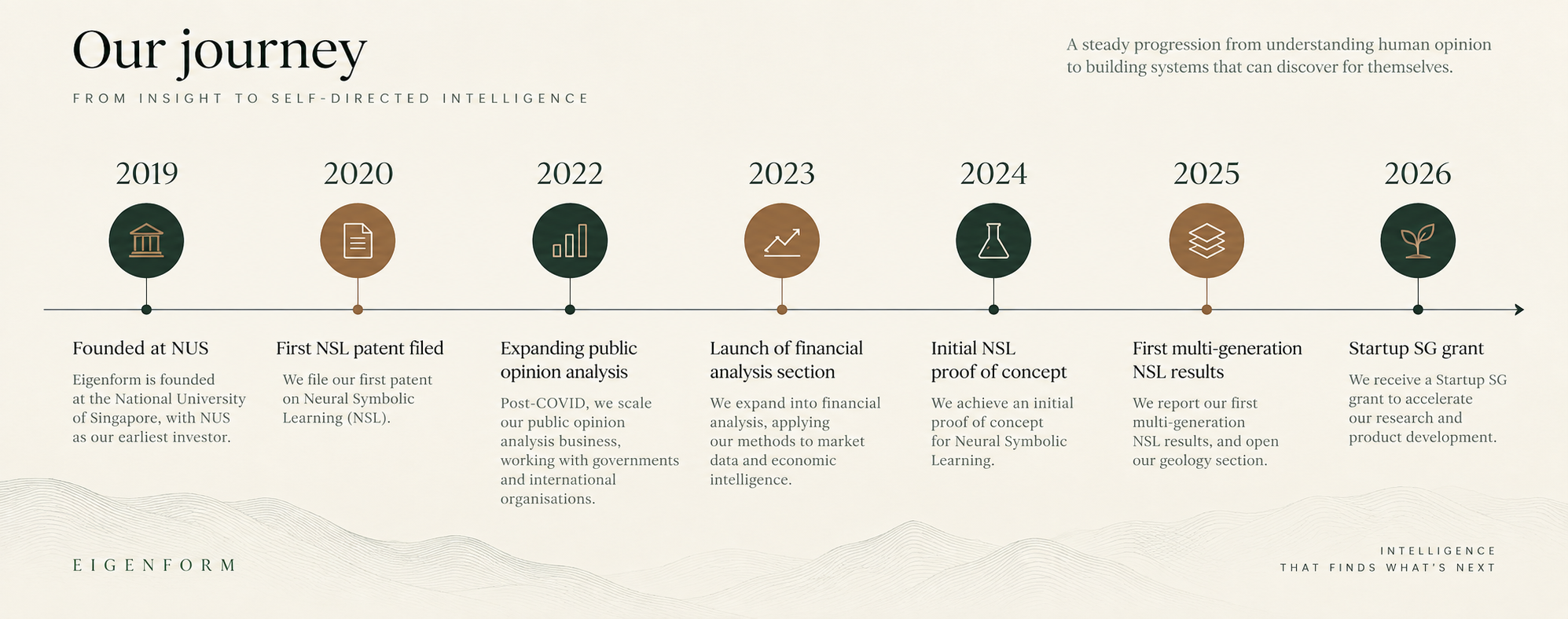
Eigenform was founded in 2019 by two researchers from the National University of Singapore: Jen Dodgson and Pei Junjie.
Our earliest work began with a comparatively simple question: how much could we learn about human societies from the enormous quantities of language they produced?
We developed systems using word embeddings and natural-language processing to analyse public opinion and large unstructured datasets. That work brought us into projects with organisations including the World Bank, Seoul National University, the University of Hong Kong and Singapore government agencies.
Organisations Eigenform has worked with

But it also led us towards a more fundamental problem.
A model trained to recognise patterns in existing data can tell you what it has learned. Could a model instead decide what it needs to learn next?
That question increasingly became the centre of Eigenform’s research.
From models that answer questions to systems that ask them
Since then, our work has moved from analysing existing information towards building AI systems capable of generating and testing their own hypotheses.
Rather than treating intelligence as a static model produced at the end of a training run, we treat it as a continuing process: observe the environment, propose an explanation, test it, retain what works, and use the result to determine what to investigate next.
We have explored this approach across mathematics, software, cybersecurity and scientific modelling. Today, some of its most demanding real-world applications are in the earth sciences, where our systems must reason over incomplete, contradictory and frequently decades-old evidence to construct and test models of what lies underground.
The domain changes. The underlying research question does not:
How far can an intelligent system learn to direct its own improvement?
Intelligence grounded in reality
We are interested in superintelligence, but not as an abstract prediction about what might happen someday.
We are interested in building the machinery that could make increasingly autonomous intelligence possible and testing it against problems where being convincingly wrong is not good enough.
That means agents that experiment rather than merely generate. Systems that preserve and build upon useful discoveries. Models whose reasoning can be inspected and challenged. Learning processes in which the external world, rather than another model’s opinion, provides the final constraint.
Our long-term goal is AI that does more than execute increasingly complicated human instructions. We want to understand how to build systems capable of developing their own productive lines of inquiry: discovering problems worth solving, constructing ways to solve them, and becoming better researchers through the process.
That is what we mean by self-directed superintelligence.
Eigenform began by asking what machines could discover in the information we had already created. We are now interested in what they can discover for themselves.