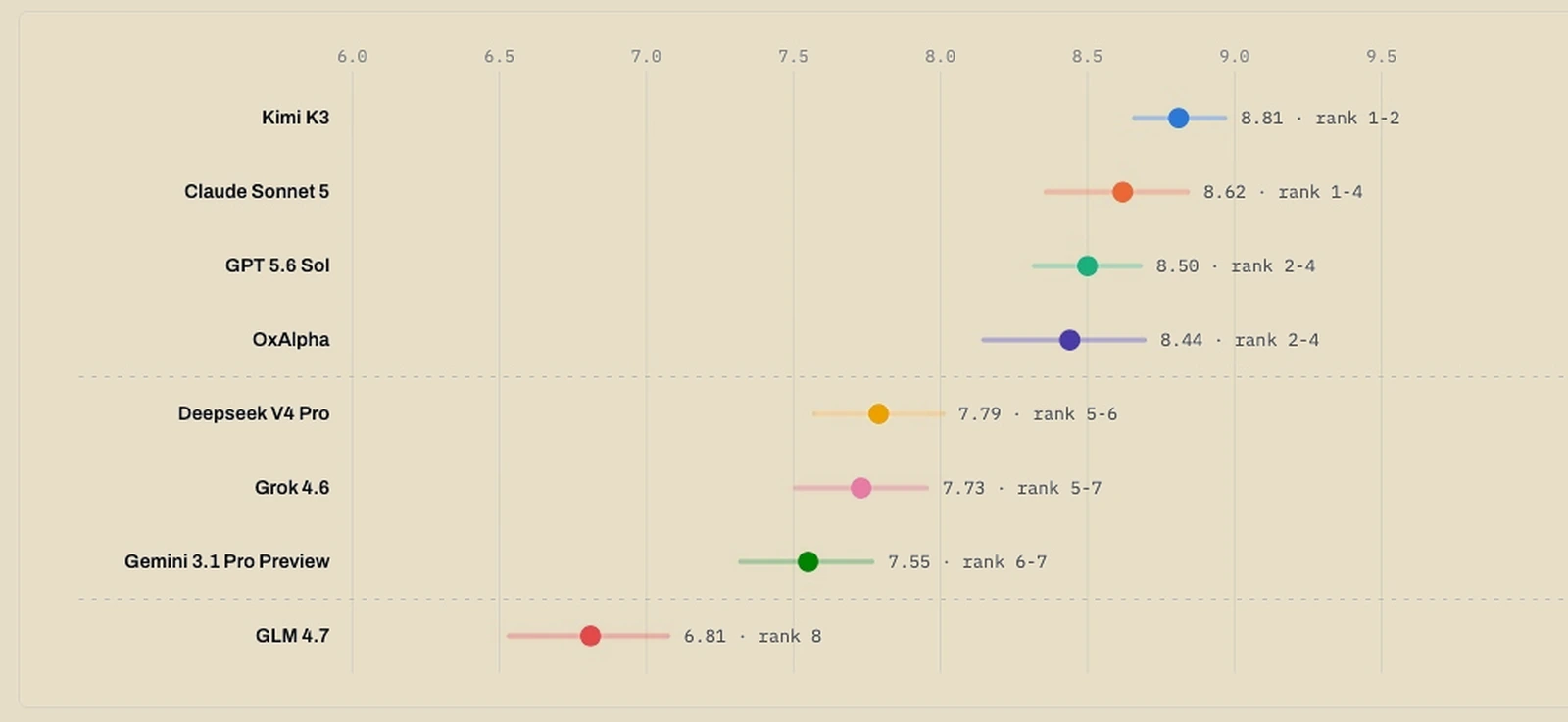
General benchmarks measure overall ability. Groundtruth is the one built specifically for geology: whether a model, or the harness wrapped around it, can read an actual exploration report or government geological filing and answer questions about what the document actually says, not what a model already knows about geology in general. The questions are not written by hand. They come from the same corpus-to-benchmark pipeline described in Dynamic Benchmarking, with every rubric line traced to a passage in the source and the finished set held private so no model can train on it.
The grading model is never the one being tested. It scores each answer from 0 to 10 against the rubric, either pointwise (one judge pass per question) or pairwise, judging two models’ answers together with each ordering used once so answer order doesn’t count. It also marks any answer that brings in material from outside the corpus. The rubrics are built so a high score is hard to fake. Each question has a pass/fail gate that must be cleared before any partial credit counts. The partial-credit points don’t overlap, some concepts are required for a full mark, and a do-not-credit list rules out common mistakes. The judge shows which parts of each answer earned credit.
Version 1.1.0 added the public leaderboard. Behind it are three 50-question sites, built from Western Australian exploration reports, USGS records, and NI 43-101 technical filings. A fourth, smaller site covers the Yudnamutana Copper district in South Australia, using 34 openly licensed deposit records (CC BY 4.0) as a worked example. If a model or a harness can be trusted on geology, this is the benchmark that shows it: not a general-knowledge quiz, but the actual documents the work runs on.