1. The early exploration capital problem in mineral exploration
In mineral exploration, geological assets often need significant technical work before they are investable, and the AI earn-in joint venture (JV) model addresses the stage where financing that work is hardest.
Mineral exploration has an awkward capital problem. The earliest stages of a project are often where relatively small amounts of technical work can create the greatest increase in value: recovering historical data, integrating old and new surveys, developing a coherent geological interpretation and identifying targets worth testing.
But this is also the point at which capital is hardest to obtain. Projects need evidence to attract investment, while producing that evidence requires investment in the first place.
2. Why AI changes the exploration equation
A growing fraction of the pre-drilling workflow is computational: recovering historical knowledge, structuring datasets, testing geological interpretations, ranking hypotheses and generating targets.
AI changes some of these economics. Much of the work between acquiring an exploration asset and putting a drill into the ground is fundamentally information work. Historical maps and reports can be reconstructed into machine-readable datasets; geological observations can be compared across thousands of records; competing models can be tested against the available evidence; and prospective areas can be ranked before expensive field programmes begin.
None of this eliminates the need for geologists, drilling or assays. It does mean that more geological uncertainty can be attacked computationally before capital is committed physically. We have run this end to end on a disguised Western Australian goldfield in our Coe Fairbairn case study.
3. The AI earn-in JV model: from software vendor to technical co-investor
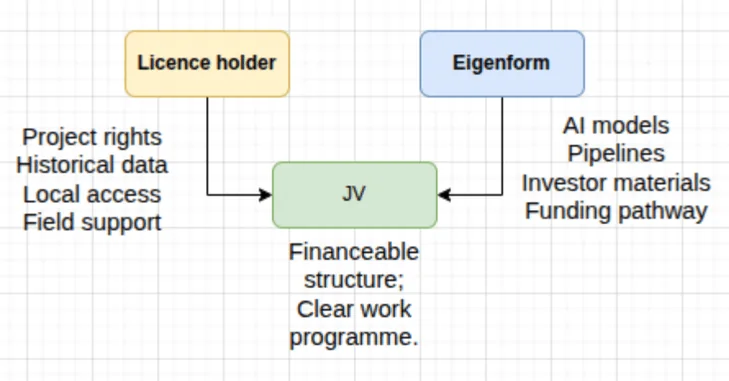
Rather than charging entirely in cash, the AI company can put technology and technical work at risk alongside the exploration company in exchange for an interest in successful projects.
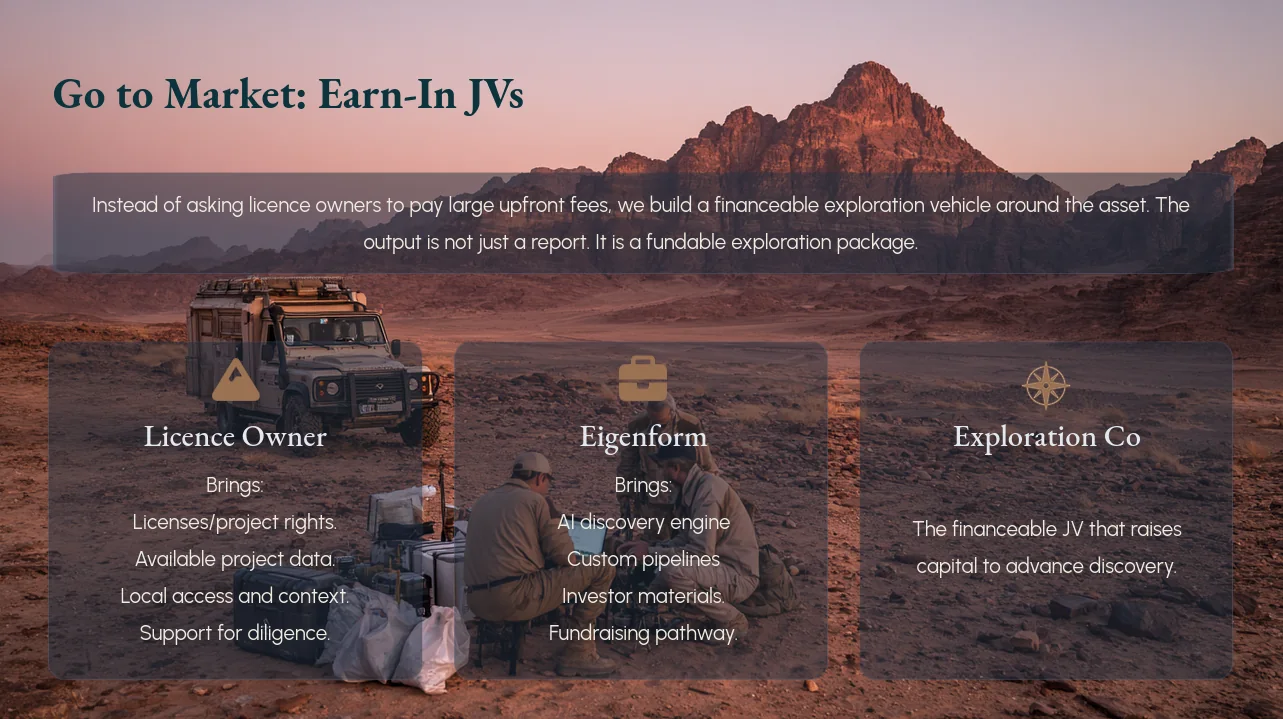
This creates a different joint venture model for mineral exploration: the computational earn-in. Instead of acting solely as a software supplier, an AI company contributes technology, compute and technical work to a project in exchange for an interest in its success. The exploration company contributes its assets, geological knowledge and operating capability; the AI partner takes on part of the early technical risk. Cash can then be concentrated on the things that still stubbornly require cash: fieldwork, sampling, permitting and drilling.
4. Portfolio economics of an AI earn-in joint venture
One AI company can apply the same infrastructure across many assets, while one explorer can try several AI partners. Exploration is naturally high-variance; software has very low marginal replication cost.
The economics become particularly interesting across a portfolio. Exploration is intrinsically uncertain, but software is unusually reusable: the infrastructure developed to analyse one project can be applied to the next at relatively low marginal cost. An AI company can therefore take technical risk across multiple assets in much the same way an exploration group takes geological risk across multiple targets. A successful project pays for a great many unsuccessful hypotheses.
5. A faster route to investability
The objective is not “AI discovers a mine.” It is to move an underworked asset from a pile of historical information and a geological thesis to structured evidence, defensible targets and an executable programme, with less upfront capital and elapsed time.
For junior explorers and project generators, the prize is not simply lower consulting costs. It is a shorter, less capital-intensive route from an underworked geological asset to something investors can actually evaluate: structured data, explicit geological hypotheses, ranked targets and a programme for testing them. In some cases that helps an existing company advance an asset. In others it helps assemble and mature projects toward financing, acquisition or listing.
We have already begun putting the model into practice. In 2026, Eigenform signed its first AI-assisted exploration joint venture with ASX-listed Lightning Minerals, combining Eigenform's computational geology work with an active exploration programme. We do not expect every project to suit this structure, and we do not expect AI to turn bad geology into good geology. The interesting cases are those where substantial geological information already exists, but extracting its full value has historically been too slow or expensive.