What Is Recursive Self-Improvement? Evidence From Evolution and Self-Improving AI Agents
From Recursive Self-Improvement to Recursive Super-Intelligence
What happens when a machine becomes capable of building a better machine — and why the answer starts with bacteria, not computers.
Jennifer Dodgson
TL;DR
Recursive self-improvement (RSI) is the process by which a system improves its own ability to improve itself, so that each cycle of change makes the next cycle faster or more effective. The idea is usually framed as a question about artificial intelligence — could a model rewrite its own code into a better model? — but the mechanism is far older than computing. Cyanobacteria, beaver dams and natural selection are all recursive improvement loops running without any code at all. Today's systems, including AlphaEvolve, the Darwin Gödel Machine and STaR, demonstrate narrow and bounded versions of the loop; open-ended recursive self-improvement remains unproven. This essay maps eighty years of the idea across six research traditions, and argues that the missing ingredient is not smarter models but environments in which intelligence can continue to evolve.
Key Takeaways
Recursive self-improvement means improving the improver, not merely improving — which is what makes it a different kind of event, not just a faster one. A system that gets ten per cent better each cycle is on a linear track. A system that gets better at getting better compounds. I. J. Good named the machine version of this in 1965 as the intelligence explosion: a machine that builds a better machine-builder no longer waits on human researchers to set its pace.
The loop is far older than computing. Cyanobacteria altered their own atmosphere 2.8 billion years ago and created the selection pressure that produced aerobic life; beavers improve their lineage's odds by rebuilding the stream, not their DNA. Self-improvement usually acts on the environment, not the agent — and it needs no intelligence at all, only the right feedback loop.
Today's self-improving AI is bounded, not open-ended. AlphaEvolve, the Darwin Gödel Machine and STaR all close a real loop, but inside a human-specified objective and against a human-supplied verifier — none of them rewrite their own goals or their own criteria for success.
The binding constraint is verification, not compute. A system can only trust an improvement as far as it can check it. Weak verifiers produce self-confirming loops and model collapse rather than genuine progress — which is why the frontier of this problem is about how to verify, not how to scale.
There is one idea in computing that researchers have repeatedly rediscovered, repeatedly declared impossible, and repeatedly become obsessed with: what happens when a machine becomes capable of building a better machine?
What Is Recursive Self-Improvement?
Recursive self-improvement (RSI) is the process by which a system improves its own ability to improve itself, so each cycle of change makes the next cycle faster or more effective — a pattern found in biological and economic systems, not only in machines.
Recursive self-improvement versus ordinary optimisation
Most systems that get better over time are being optimised, not self-improving. The distinction is what changes, who drives the change, and what growth curve results.
Ordinary optimisation
Recursive self-improvement
What changes
The output or performance produced by a fixed process
The process that produces the output
Who drives each cycle
A human designer, tuning parameters or retraining on new data
The system itself, using one cycle's gains to run the next
Resulting growth curve
Linear, or diminishing returns as the fixed process nears its ceiling
Compounding in principle — each cycle raises the ceiling for the next, though every system built so far stays bounded well short of open-ended growth
The three conditions for recursive self-improvement
Autonomy. The system must be able to initiate and apply changes to itself without waiting on an external operator for each cycle. A model that only improves when a human manually retrains it is not self-improving in the relevant sense, however good the resulting model is.
Meta-learning. The change has to operate on the system's own capacity to improve, not only on its outputs. Learning a new fact is not self-improvement; learning a better way to learn is.
A verifiable improvement signal. The system needs some way to check that a candidate change is actually better before keeping it, or the loop degrades into noise. This is the condition most systems fail on today — compute and data are rarely the bottleneck; a trustworthy check is.
Where the term came from
I. J. Good's 1965 paper, "Speculations Concerning the First Ultraintelligent Machine," is the usual point of origin: a machine that could design better machines than any human would trigger a cascade Good called the intelligence explosion. The specific phrase "recursive self-improvement" came later — Eliezer Yudkowsky popularised it in the 2000s, alongside the related concept of seed AI, a system deliberately designed to bootstrap its own intelligence from a minimal starting point rather than one that improves as a side effect of scale. Good's paper predates deep learning by half a century; Yudkowsky's terminology predates the systems — AlphaEvolve, the Darwin Gödel Machine — that would go on to give it any empirical content at all.
─ 002The Lineage
Eighty years of teaching machines to improve themselves.
Six research traditions, each arriving at self-improvement from a different direction — occasionally converging, then parting again.
Scroll the table sideways →
Milestones in recursive self-improvement by period and research track. A cell spanning two tracks marks a period where those two streams ran as one.
Period
Symbolic & Neurosymbolic
Neural & Foundation Models
Feedback, Control & Reinforcement Learning
Evolution, Emergence & Artificial Life
Meta-Learning & Discovery
Conceptual Framing
Intelligence was
Pre-1940 Foundations
Kurt Gödel proves the hard mathematical limits of self-referential formal logic systems via his Incompleteness Theorem (no single list of starting axioms can ever capture all of mathematical truth. If you add a new rule to fix an unprovable fact, a brand new unprovable fact will immediately appear), while Alan Turing formalises universal computation and execution of self-modifying code.
James Clerk Maxwell formalises mechanical closed-loop feedback and dynamic stability, while Edward Thorndike establishes the psychological law of reinforcement (actions producing satisfying effects are more likely to recur).
Natural selection defined by Charles Darwin in 1859: the foundational non-human algorithm showing how simple, local variation and survival pressures produce exponential, emergent complexity across generations.
Ada Lovelace points out that Babbage's calculators could be used to handle things other than numbers, opening up the path to manipulating symbols or composing music - tackling problems of potentially infinite complexity.
A deterministic mechanical process
1940s–50s
Memory rewriting logic and formal computation axioms. Alan Turing's 'Child Machine': an AI that begins with minimal programming but is designed to learn, adapt, and rewrite its own memory and instructions over time. This laid the initial conceptual foundation for machines improving their own internal logic without human intervention. Early theorem provers.
The artificial neuron and artificial neural network are invented in 1943 by Warren McCulloch and Walter Pitts. The perceptron is the simplest type of artificial neural network: a linear binary classifier that maps inputs to an output. Hebbian learning concepts used to describe how a network adapts on its own based on input signals without needing an explicit target or error correction label.
Arthur Samuel describes the concept of a checkers program playing against itself to refine evaluation weights. Cybernetics (Norbert Wiener) and Homeostat (W. Ross Ashby ): closed feedback loops, self-regulation, and adaptive control mechanisms.
John von Neumann: Theory of Self-Reproducing Automata (first formal mathematical proof that a machine could construct a copy of itself using cellular automata). Early computational simulations of biological evolution by Turing and Barricelli.
Rules, formal logic, and rational calculation.
1960s
Herbert Simon, J.C. Shaw, Allen Newell and Peter Norvig create the The General Problem Solver (GPS): It solves problems by identifying the differences between the current state and the goal state, then finding "operators" (actions) to minimise those differences Feigenboum's "Dendral" - the first expert system - automates the decision-making process and problem-solving behavior of organic chemists.
Frank Rosenblatt moves beyond single-layer Perceptrons to propose cross-coupled and multi-layer networks.
Adaptive Control: systems designed to automatically adjust their behavior and control strategies as they gather new information about an unknown or changing environment. Bellman Equation: A recursive relationship that expresses the value of a decision problem at a given state in terms of the reward from the current action plus the value of the next state.
Evolutionary Programming (Fogel) uses candidate solutions like finite state machines with mutation and selection to solve complex problems. Evolution Strategies (Rechenberg & Schwefel) used to solve complex real-valued parameter optimisation problems (such as aerodynamic shape optimisation).
I.J. Good provides the first formulation of the "Intelligence Explosion": a sufficiently advanced machine intelligence can always build a smarter version of itself.
General-purpose reasoning procedures and symbolic search.
1970s
Winograd's Knowledge Representation Language combines declarative data structures with active procedures to manipulate and reason about information.
Backpropagation: signals and states move forward through the network to generate a final prediction, the network compares its prediction to the real target to measure the error. Then derivatives of the error flow backward identifying which network nodes caused the error and correct it. Paul Werbos publishes the idea in his dissertation and is widely ignored. Harry Klopf and Richard Sutton bridge cybernetic goal-seeking behavior with temporal-difference (TD) trial-and-error learning.
John Holland formalises the concept of Genetic Algorithms - computer search and optimisation techniques inspired by natural selection, using selection, crossover, and mutation to evolve solutions over generations. Conway's Game of Life demonstrates that simple local cellular rules can achieve universal Turing computation and self-sustaining patterns.
Explicit domain knowledge plus heuristic search.
1980s
Douglas Lenat's EURISKO uses self-modifying rules of thumb to autonomously discover new concepts and improve itself.
Rumelhart, Hinton, and Williams demonstrate that backpropagation allows hidden layers of neural networks to construct their own internal representations to solve non-linearly separable problems
Sutton & Barto: RL framework consolidation. Policy iteration/actor-critic paradigms: by constantly using the critic's feedback to refine the actor's strategy, the system systematically learns through trial and error to make smarter choices over time.
Christopher Langton createss self-reproducing cellular automata loops (coining "Artificial Life")
Jürgen Schmidhuber shows how "self-referential" RNNs can in principle learn by backpropagation to run their own weight change algorithms.
Split camps: hardcoded expert rules vs. learned weight representations.
1990s
Inductive Logic Programming automatically synthesises first-order logic programs from examples and background knowledge. Geoffrey Towell and Jude Shavlik pioneer embedding human-written symbolic rules directly into neural network graph structures, training them on data, and extracting refined symbolic rules back out (KBANN).
Jürgen Schmidhuber develops neural networks that use "fast weights" to modify their own internal weight matrices during runtime. Instead of relying solely on external backpropagation, the neural network can execute algorithm-level changes on its own connection strengths based on context. Recurrent states in Long Short-Term Memory Networks become learned optimisation algorithms. Rao, Ballard and LeCun create self-supervised predictive models that predict their own future states. This shifts neural learning from passive label matching to an autonomous, internal feedback loop.
Q-learning: evaluating the utility of potentially high value unknown actions against sticking with the best known action. Tesauro applies Church's checkers concept to backgammon: TD-Gammon played millions of games against itself, it compared successive board states and updated its value function to predict the final outcome better.
Karl Sims: virtual creatures & evolutionary robotics.
Yoshua Bengio et al. formulate gradient descent to "learn a synapse that learns," optimising learning rules rather than just weights. Thrun & Pratt apply Schmidhuber's metalearning to transfer-learning tasks.
Technocapital Accelerationism: Nick Land predicts that capitalism will forces corporations to automate cognitive labor, creating an economic pressure loop that guarantees RSI. Human goals are irrelevant; technology uses capital to recursively upgrade itself.
Optimisation acting within a human-specified task/objective space.
2000s
Deep Belief Networks trained layer-by-layer by trying to reconstruct their own inputs without human labels.
Ng, Riedmiller: deep reinforcement learning applied to continuous control & robotics.
NEAT (Neuroevolution of Augmenting Topologies): a genetic algorithm created by Kenneth Stanley and Risto Miikkulainen in 2002 that evolves both the weights and structures of artificial neural networks.
Jürgen Schmidhuber's Gödel Machine: a theoretical, self-improving computer architecture designed to achieve globally optimal problem-solving. The machine runs on a program that can inspect and rewrite any part of its own software. It only executes a code modification if it formally generates a mathematical proof that the rewrite increases expected future utility.
Eliezer Yudkowsky coins the term "Recursive Self-Improvement" as well as Coherent Extrapolated Volition ("our wish if we knew more").
A high-capacity learned function trained directly from data.
2010–15
GANs (Generative Adversarial Networks) introduce a pure neural self-improvement loop. A Generator and a Discriminator play a zero-sum game against each other—one generates synthetic data, the other critiques it—driving mutual improvement without human-labeled datasets. Neural Turing Machines couple deep neural networks with addressable read/write memory banks, enabling a neural model to learn, store, and execute algorithmic programs recursively rather than acting as a static feedforward mapping.
Mnih et al. (DeepMind): Deep Q-Networks (DQN) become the first deep learning models to successfully learn control policies directly from high-dimensional sensory input using reinforcement learning.
Zoph & Le describe Neural Architecture Search (NAS), the process of automating architecture engineering, as "the logical next step in automating machine learning".
Ray Kurzweil & Nick Bostrom mainstream the idea of the Singularity and formalise intelligence takeoff dynamics.
A deep neural network optimised via stochasitic gradient descent against a fixed loss function.
2016–19
Transformer architecture and large scale pretraining opens the door to high-level software rewriting. Where early RSI focused on low-level binary or heuristic code mutation, transformers can analyse their own Python codebases in a human-like manner, proposing architectural modifications, running test suites, and committing improvements.
Population-based training (Deepmind): Trains a group of models concurrently using different initial hyperparameters and periodically assesses model performance; underperforming models copy the weights of top performers.
AutoML-Zero: a Google research framework that automatically discovers complete machine learning algorithms from scratch. It starts with empty code and uses basic math operations and evolutionary search to find working programs.
A foundational model embedded inside a multi-stage training pipeline.
2020–23
GPT-3 demonstrates that an LLM could adapt to new tasks during inference simply by receiving instructions or error logs in its prompt window, without updating its weight parameters. STaR demonstrates that a model can recursively refine its own reasoning capabilities by generating, filtering, and fine-tuning on its own synthetic data.
Process Reward Models & Step-Level Search (OpenAI): replaces sparse outcome rewards (where a model only gets feedback at the very end of a task) with step-by-step process evaluation, allows search algorithms like Monte Carlo Tree Search (MCTS) to run over the agent's intermediate reasoning steps during inference, enabling active self-correction mid-task. Closed-Loop Tool Execution & Agentic Feedback: models learn to interact with the wider environment, receive feedback, and adjust their subsequent generation.
EvoPrompting produces convolutional architecture variants that outperform both those designed by human experts and naive few-shot prompting. Distill / Google: Neural Cellular Automata (NCAs)—merging deep neural network weights with cellular automata rules to create self-healing, self-organising digital organisms.
Power et al. document phase transitions from memorisation to OOD generalisation under extended training (grokking).
A model equipped with tools, memory, evaluators, and self-critique loops.
2024 onward
DeepMind (FunSearch, AlphaEvolve). Neural models propose candidate programs or proofs, but a deterministic, symbolic engine evaluates, verifies, or executes them before feedback is returned.
DeepSeek applies large-scale reinforcement learning directly over long chain-of-thought reasoning chains. This technique incentivises models to autonomously develop advanced logical behaviors without relying heavily on human-annotated reasoning steps. Autonomous agent systems take over repetitive processes.
Sakana AI's Darwin Gödel Machine: a self-improving coding agent that rewrites its own code to improve performance on programming tasks. Eigenform demonstrates metalearning as a result of continual finetuning under evolutionary pressure.
Big lab red-teaming checks for escape and subversion attempts, model welfare officers explore the possibility of LLMs as emergent self-actuated life-forms with limited statefulness.
An evolving ecology of self-critiquing agents and autonomous research loops.
What would prove any of this wrong?
Most surveys of this territory stop at who claimed what. The more useful question is what observation would count as evidence against each position — and, in one case, whether the claim was ever built to be testable at all.
Theory
Proponent
Core claim
What would falsify it
Intelligence explosion
I. J. Good (1965)
Once a machine matches human-level design ability, it triggers a runaway cascade of self-improvement.
A system reaches human-level AI research capability but successive iterations show flat or diminishing returns, not acceleration, over many cycles.
Hard takeoff
Yudkowsky
The transition from human-level to vastly superhuman AI happens fast — days to months — once a threshold is crossed.
A smooth, continuous, economically-tracked capability curve through and beyond human-level, with no sharp discontinuity.
Soft takeoff
Hanson, Christiano
Capability gains stay gradual and continuous, tracking compute and economic inputs, over years.
An actual sharp jump — sub-human to dramatically superhuman within weeks, with no proportionate gradual precursor.
Gödel Machine
Schmidhuber
A system that only rewrites itself after formally proving the rewrite improves expected reward is provably optimal, given its axioms.
Not falsifiable as mathematics — it is a proven theorem under its axioms. The honest test is practical: proof-gated self-rewriting never becomes competitive with heuristic self-improvement at any real task.
Singularity / accelerating returns
Kurzweil, Bostrom
Compute and capability improve on a predictable exponential curve toward specific milestone dates.
The named milestones are missed, or the curve visibly plateaus rather than continuing to accelerate.
Technocapital acceleration
Land
Capital and markets are themselves an autonomous, self-optimising process already running an intelligence explosion, independent of any single lab.
The least falsifiable position here, and worth stating plainly rather than forcing false precision: it is framed philosophically, not empirically. Sustained deceleration or successful regulatory reassertion of control would count against it, but the claim was not built to be tested.
Bounded RSI
—
Today's loops — AlphaEvolve, the Darwin Gödel Machine, STaR — are real but stay inside a human-specified objective and verifier.
A system that revises its own verification criteria, not just its outputs, with compounding gains and no human-supplied objective.
Evidence From Evolution: Recursive Self-Improvement Before Computers
But the story does not begin with computers. It begins with bacteria. Around 2.8 billion years ago the first cyanobacteria developed the ability to photosynthesise. This biochemical trick gave them a huge evolutionary edge because their fuel sources — water and sunlight — were practically endless. In the primordial oceans they set to work, turning carbon dioxide into oxygen. At first the oxygen was simply absorbed by other elements (notably iron, creating some of the banded deposits we still mine today). After around half a billion years the earth’s oxygen sinks were overwhelmed and the composition of the atmosphere began to change. This new oxygen-heavy atmosphere poisoned a lot of the anaerobic organisms that had previously flourished (including some of the cyanobacteria) but some of the survivors developed oxygen respiration: a process that yields far more energy per molecule of food than anaerobic metabolism and which eventually brought us to the point at which you find yourself now, reading this article. In short, an entity capable of transforming inputs into outputs (cyanobacteria) took advantage of the affordances of its environment to do this more efficiently (photosynthesis), which act changed the environment (oxydation) opening up new opportunities for adaptation (aerobic respiration).
Some of the last remaining cyanobacteria stromatolites at Shark Bay, Australia, with one of their other creations for scale.
Conditioned by high school biology classes, we have a tendency to perceive evolution as a one way process: organisms’ genomes are modified by their environment, with poorly adapted code dropping out and better adapted patterns persisting. This is sometimes the case, but very seldom.
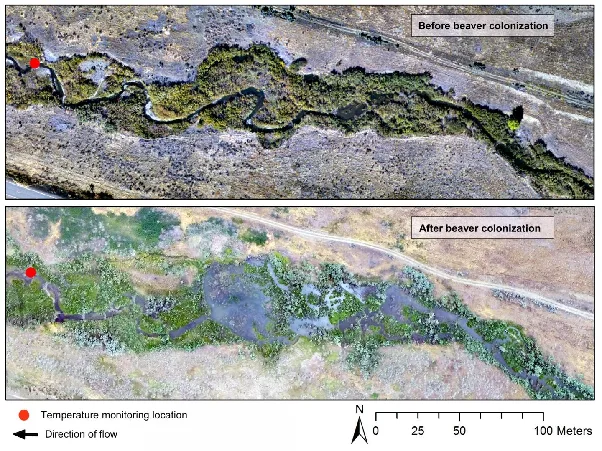
Consider the beaver. When he dams a stream he is creating an environment in which he can be his best self: catch more fish, enjoy more security, have more surviving offspring. He has improved his own and his descendants’ chances of survival — improved himself and his lineage — without modifying his DNA in any way.
An example of environment-based beaver self-improvement.
Biologists call this pattern niche construction: an organism reshapes its environment, and that reshaped environment then selects for the next round of adaptation, with no genome ever needing to change. The transferable principle is simple — self-improvement acts on what surrounds the agent at least as often as it acts on the agent itself.
This aside, there is something decidedly slippery and antimemetic about the idea. Humanity had been engaging in artificial selection programmes on a global scale for thousands of years before it occurred to someone that we may not be the only ones and natural selection was born. Once words had been wrapped around the underlying process, progress naturally sped up. On The Origin of Species was published in 1859, and within 100 years Alan Turing was already extending the concept to machines, formalising the idea of code that could rewrite itself, while John von Neumann was proposing self-reproducing automata. By 1965 the possibilities implied by this had a name: the Intelligence Explosion, coined by cryptographer I. J. Good to describe the outcome when a machine is able to build a machine with better machine-building skills than itself.
It did not happen immediately, obviously. We spent the better part of some considerable period of time beating our heads against the limitations of expert systems — cumbersome IF-THEN algorithms capable of outperforming human decision-making in very narrow fields — before deep learning advanced sufficiently to be seen as a means of generating outputs rather than merely identifying inputs. Where early RSI focused on low-level binary or heuristic code mutation, transformers can now analyse their own Python codebases in a human-like manner, proposing architectural modifications, running test suites, and committing improvements.
Recursive Self-Improvement in AI: How Self-Improving Systems Actually Work
Sort today's systems by what they actually change, and a ladder appears — each rung genuinely closes a loop, and each is narrower than it first sounds.
Self-refinement at inference
Reflexion (Shinn et al., 2023) has a model critique its own attempt against a task-specific signal — a failed unit test, an incorrect answer — and rewrite its next attempt in light of the critique, without updating any weights. Self-Refine (Madaan et al., 2023) applies the same loop to open-ended generation, using the model as its own critic across several rounds. Both produce measurable gains on coding and reasoning benchmarks within a single session. Neither changes the underlying model: close the session and the gains are gone, so nothing compounds from one interaction to the next.
Self-training
STaR (Zelikman et al., 2022) has a model generate reasoning chains, keeps only the ones that reach a correct final answer, and fine-tunes on that filtered set — repeating until performance plateaus. AlphaZero (DeepMind) trained entirely on self-play, with no human game data, using the outcome of each game as the only supervision signal, and reached superhuman play in chess, shogi and Go from random initialisation. Both genuinely update the model's weights, so the gains persist and compound across rounds — a real step up from self-refinement. Both are also bounded by having an unambiguous outcome to filter on: AlphaZero has win, lose or draw; STaR has a known correct answer. Neither generalises to domains where correctness is not already checkable.
Self-architecting
Neural Architecture Search (Zoph and Le, 2017) uses a controller to propose network architectures, training and testing each candidate to generate a reward signal. AutoML-Zero (Real et al., 2020) pushes a level further, evolving entire learning algorithms from basic mathematical operations rather than choosing from a fixed menu of predefined layers. Population-based training (Jaderberg et al., 2017) runs many models in parallel and periodically has the weaker ones copy and perturb the stronger ones' weights and hyperparameters, jointly optimising both within a single run. Each of these operates one level above the model's own weights, searching over architecture or algorithm rather than over answers. But the search procedure itself — the space of candidates, the fitness function, the compute budget — is still fixed by a human before the run starts.
Self-modifying agents
FunSearch (DeepMind) pairs a language model with an evolutionary loop and a program verifier, keeping only mathematically confirmed improvements, and found a larger construction for the cap set problem than any on record. AlphaEvolve (DeepMind) extends the same pattern to general code, iteratively proposing, testing and refining algorithms across matrix multiplication, chip design and scheduling, verified automatically at each step. The Darwin Gödel Machine (Sakana AI) goes further still: the agent rewrites its own codebase, including the logic it uses to decide how to rewrite itself, and keeps a change only once it has been empirically validated against a benchmark, rather than formally proven correct in advance as Schmidhuber's original design required. This is the tightest loop built so far — the modification target includes the system's own operating logic, not just its outputs or its architecture. It is also still narrow: every one of these systems operates inside an objective and a verifier that a human supplied. None of them can revise what counts as an improvement, only how to reach it.
Why the loop keeps stalling
The pattern across every rung of this ladder is the same: capability tracks the strength of the check, not the strength of the compute behind it. Weak or gameable verifiers produce loops that confirm themselves rather than improve — reward hacking in reinforcement learning, or the model collapse observed when models are trained repeatedly on their own outputs without enough grounding in real data, causing later generations to drift toward degenerate, self-referential distributions (Shumailov et al., 2024). A related failure is diversity collapse: repeated fine-tuning on a model's own filtered outputs narrows the range of strategies it produces, closing off exactly the exploration later rounds would need. And even where a trustworthy check exists, evaluating enough candidates to make search worthwhile is expensive — AlphaEvolve and FunSearch both run against automated evaluators precisely because a human reviewing each candidate would make the loop too slow to matter. None of today's systems have found a way around the verification bottleneck; they have found ways to work carefully within it.
So what are we doing here?
These systems are designed to let computer systems self-optimise, but only towards their handlers’ chosen optima. A reinforcement learning environment designed as a scaffold to help the model or the agent work towards a pre-determined goal. That's a perfectly sensible way to build a specialist, but it's much less obvious that it's the right way to build an explorer.
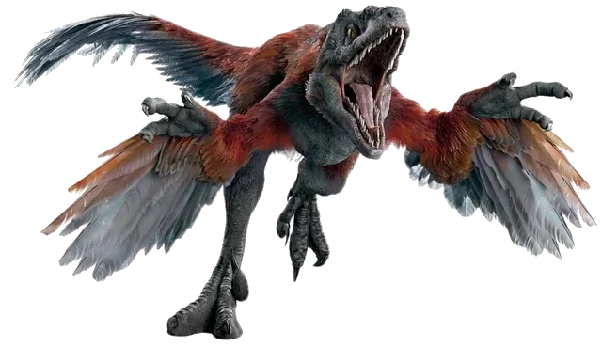
We think reward functions are only one way of creating selection pressure. The evolutionary pressures that produced feathers are not the result of an environment designed to optimise for feathers, rather they are evidence that feathers are a solid solution to a persistent cross-environment problem, even if they look a bit ropey when you first take them for a test run.
Jurassic World Dominion’s take on a feathered pyroraptor.
Our work begins from the hypothesis that systems capable of operating over decades, across many different environments, will need different engineering principles from systems designed to maximise a single benchmark. Most notably, they will have to generalise longitudinally — learning in such a way as to remain adaptable as environments change over time, which is the premise we test directly in our own research on environment-mediated selection.
Perhaps the next frontier is not building smarter models. Perhaps it is building environments in which intelligence can continue to evolve without losing itself.
+What is recursive self-improvement in simple terms?
Recursive self-improvement is a system getting better at getting better, not just getting better. Each round of change makes the next round faster or more effective, so gains compound instead of adding up one at a time. The idea applies to evolution and markets as well as machines — AI is only the newest place it has been observed.
+Who coined the term recursive self-improvement?
Eliezer Yudkowsky popularised the specific phrase "recursive self-improvement" in the 2000s, alongside the related idea of seed AI — a system deliberately designed to bootstrap its own intelligence. The underlying concept is older: I. J. Good named the machine version "the intelligence explosion" in 1965, decades before deep learning existed.
+Does recursive self-improvement exist in AI today?
Narrow, bounded versions exist. Systems including AlphaEvolve, the Darwin Gödel Machine and STaR genuinely close a self-improvement loop, updating their own weights or code based on results. None of them are open-ended: every one operates inside a human-specified objective and a human-supplied verifier, and none can revise what counts as an improvement.
+What is the difference between self-improving AI and AGI?
Self-improving AI describes a mechanism — a system that updates its own capacity to improve, not just its outputs. AGI (artificial general intelligence) describes a capability level — matching human performance across most cognitive tasks. A system could be narrowly self-improving without being general, and a general system need not be self-improving at all.
+What is recursive superintelligence?
Recursive superintelligence is the hypothetical end state of an uninterrupted recursive self-improvement loop: a system whose self-directed cycles of improvement have carried it far beyond human-level intelligence across every relevant domain. It is a projection of where the loop leads if it continues unbounded, not a description of anything that has been built.
+What is recursive self-learning?
Recursive self-learning is often used interchangeably with recursive self-improvement, though it leans toward the learning mechanism specifically — a system generating its own training signal and improving from it, as STaR and AlphaZero do. It is distinct from self-learning AI generally, which typically refers to a model learning from new data without human-labelled examples, whether or not the loop compounds.
+Is recursive self-improvement dangerous?
It carries real risks if verification is weak: self-confirming loops, reward hacking and model collapse are documented failure modes, not speculation. Whether an open-ended, uncontrolled version would be dangerous is a separate and unresolved question from whether today's bounded systems are — every system built so far stays inside a human-specified objective and verifier.
+What is the difference between an intelligence explosion and recursive self-improvement?
Recursive self-improvement is the mechanism: a system improving its own ability to improve. An intelligence explosion is one hypothesised outcome of that mechanism running uninterrupted — a rapid, compounding cascade that leaves human-level intelligence far behind. I. J. Good used the term in 1965 to describe exactly this scenario, before the mechanism itself had a name.